
Som’s Retail Journey | Part 4
From One Café to a Retail Chain
Jun 12, 2026 | 7–8 min read
Introduction of Mr. Singh
Vishnu Priya and Som were seated comfortably on the café couch, sipping their coffees, when a middle-aged man with dusky features and long hair approached them.
Vishnu Priya welcomed him warmly. “Welcome, Mr. Singh.”
She then turned to Som and said, “Mr. Singh is my colleague and an expert in explaining theoretical concepts through practical examples. He will take you through the different retail models.”
Mr. Singh and Som shook hands. Without wasting time, Mr. Singh got straight to work and handed them a one-pager detailing different retail formats.
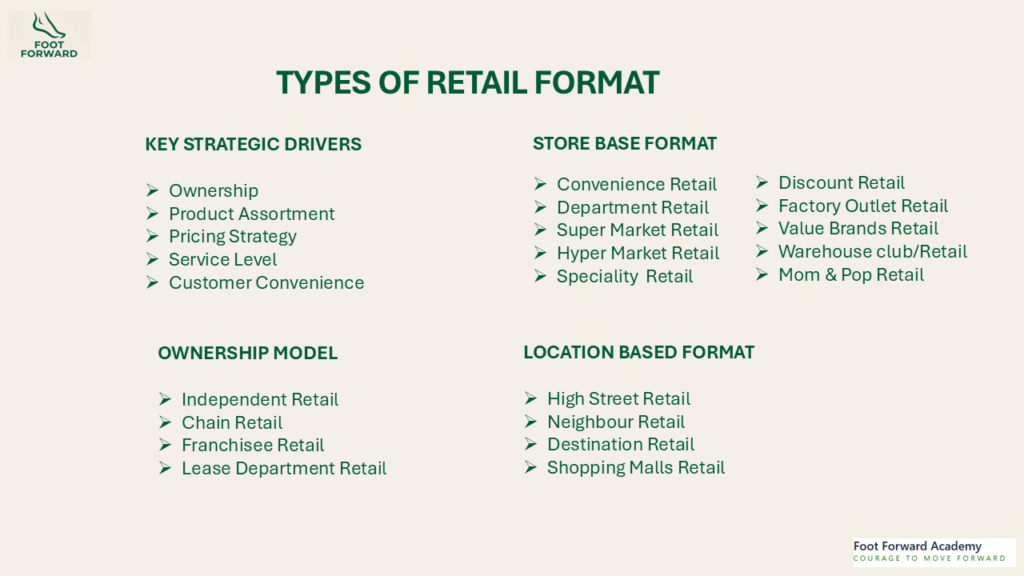
Ownership Model of Retail Formats
“Retail formats are created based on ownership, store size, merchandising, pricing strategy, service level, and customer convenience,” he explained. “Since you want to become an entrepreneur, let me begin with retail formats based on ownership.”
Ownership Retail
- 1. Individual ownership Retail
- 2. Chain Retail
- 3. Franchisee retail
- 4. Lease retail
Individual Ownership Retail
“Tell me, Som, which type of retail attracts you the most?”
Som replied, “Cafés.”
“Great! Then you are already in your beloved retail category,” Mr. Singh said. “Now suppose you want to open a café. What requirements come to your mind? Just speak freely — I’ll note them down.”
Som laughed. “You are the consultant. You should tell me.”
“Share your thoughts first,” Vishnu Priya replied. “We’ll build on that.”
Som began, “I will need a shop in a good area.” Looking around at the barista, he added, “A good team, parking, and a menu card.”
There was silence.
Mr. Singh flashed the notepad and said, “So your list is: 1. Shop, 2. Area, 3. Team, 4. Parking, and 5. Menu card.”
Som felt uncomfortable and wanted to escape the conversation. To lighten the mood, Vishnu Priya stepped in. “Do give us a lifetime discount at your new café,” she joked.
Mr. Singh smiled and returned to the basics. “Som, could you share a few more thoughts or requirements?”
“Som felt the long list would take time to process.”
Quickly, Mr. Singh changed his approach. “What is your budget? What will you offer in the café? Will it be experiential, grab-and-go, a social hub, a specialty café, a co-working space, or something else?”
This eased Som’s pressure but increased the complexity.
Mr. Singh continued, “What products will you offer? What price segment will you target? These are all questions related to product assortment, pricing strategy, service level, and customer experience.”
He explained that from the café name to customer service, everything has to be planned by the owner. This is the independent ownership format of retail.
“Mom-and-pop stores are the best example of this model,” he said. “The individual owner decides the name, builds the brand, and manages everything independently.” Other examples include boutique stores, salons, and coaching institutes. In this format, the entire responsibility lies with the owner.
Mr. Singh then asked, “Som, give me a random name for your café.”
Som replied, “AHLAD — intense inner joy or spiritual ecstasy.”
“Superb!” Mr. Singh said. “Suppose as an individual owner, you have established one café. It has become popular, profitable, and in demand. What will be your next move?”
Som said excitedly, “I will open more cafés in similar areas.”
“How many?”
“Maybe one or two to start with.”
“And if they succeed?” Mr. Singh asked.
“I will expand across the city.”
“Good,” said Mr. Singh. “Now you are moving from an individual owner to a chain retailer. You are getting into the second retail format based on ownership.”
Chain Retail
He continued, “What would your next move be?”
Som replied, “I would focus on these outlets only. Managing them will be crucial. Control will not be good for cafés far away from me or my family.”
Mr. Singh nodded. “That concern is valid. Now imagine a café brand with more than 500 branches spread across 3 or 4 Asian countries, and a turnover of over Rs. 400 crores in 2026. How would they have expanded?”
Som thought for a moment, and spoke, “Oh yes, retail chains are present. Maybe they have rules, regulations, and discipline which everyone adheres to & runs the show.”
Vishnu Priya spoke, “Excellent, Som. You are thinking in the right direction.”
Mr. Singh smiled & kept firing questions, “Who will be writing these rules and regulations? How will they be defined?”
Som said excitedly, “It’s very simple. The way of working that helped in the success of the couple of stores will be considered the benchmark for creating rules, regulations, and in fact, a proper process. I would like to write an AHLAD Journal. It will be the same as the holy book for any religion. Everyone follows that by heart & soul.”
Vishnu Priya said, “Som, the metaphor is excellent but don’t mix business & religion. We got the essence; you will define your do’s & don’ts, rules, ways of working & processes based on your experience & successful results.”
Mr. Singh asked, “How will writing this help in expansion?”
Som replied, “I would be training people who will be opening new branches of the café & will run them keeping its soul intact.”
“Great, you have created a recipe for success and trained chefs to replicate it, but you are missing one important thing.”
Som realized the point and spoke, “You are talking about capital?” “Yes, this will be a problem.”
Vishnu Priya added, “Don’t worry, you will get investors in this case. They will have a share of your business in place of their investment. You have to scale with success only; money will flow automatically.”
Som was as delighted as kids getting new toys. “Yeah! Now the expansion will have a rapid pace.”
Mr. Singh agreed, “Yes, you have to create a proper organizational structure for operations. The robustness & agility of the structure at the initial stage of expansion will ensure the success & speed of expansion. In this way, you can create your own Café Chain – AHLAD.
Starbucks at JV With TATA is the best example in India. It’s owned & operated by the company. The experience is similar at all Starbucks cafés across the length & breadth of the company. The product taste & service levels are the same for the customer. They can visit any store. They will feel like it is their own café. No change once they enter the café. It cuts you off from the surroundings. You are now in the Starbucks culture. This is what is needed to create a loyal customer base & strong brand recall.”
Vishnu Priya added, “Few more retail chains follow this, like Zara, Uniqlo, IKEA, Apple retail, PVR INOX, Pret A Manger, and Tim Hortons. This model has expanded its reach to the services sector like HDFC Bank and ICICI bank.”
Som nodded excitedly. “I get the concept of this model now. Once you achieve that initial success, it can be scaled quickly, and your success will multiply exponentially.”
Then Mr. Singh pauses him and say:
“Expansion is exciting, Som. But every growth model carries hidden risks. What works in one place does not always work everywhere.”
To be continued…