
Som’s Retail Journey | Part 5
why retail chains fail in India?
May 19, 2026 | 6–7 min read
Continuing from Som’s Retail Journey | Part 4 where Som first discovered how a single café evolves into an organised retail chain.
Som was shocked by Mr. Singh’s intervention.
The sudden silence was broken by a phone ring.
Vishnu Priya said, “This is one of our most prestigious client calls. Kindly excuse us, Som. I have to borrow Mr. Singh also for the moment.”
Both moved to another corner of the café.
Som started recapping the conversation to identify the risk elements associated with this organised retail format. He began writing down the steps for chain retail success.
The Framework of an Organised Retail Format – Chain Store
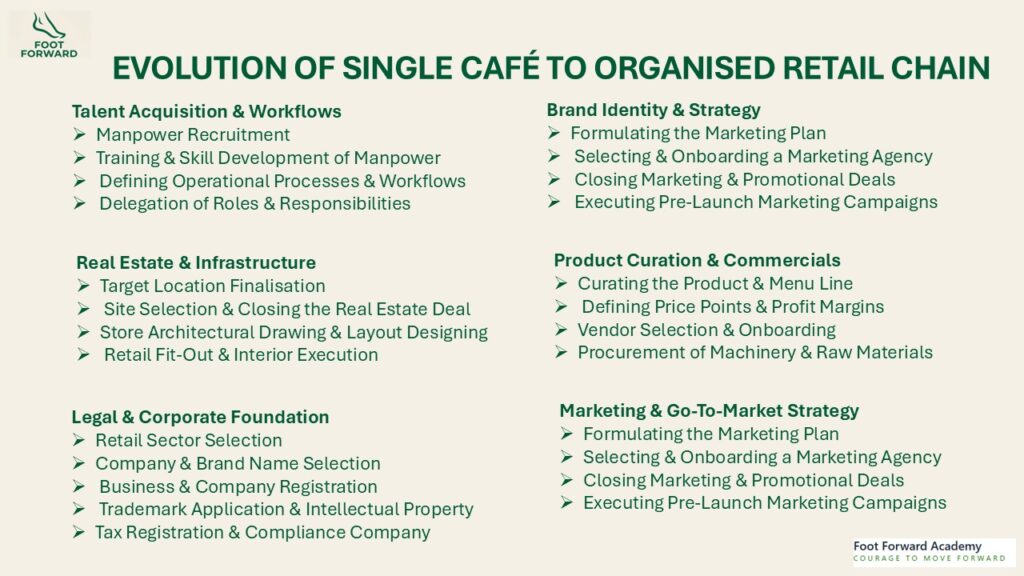
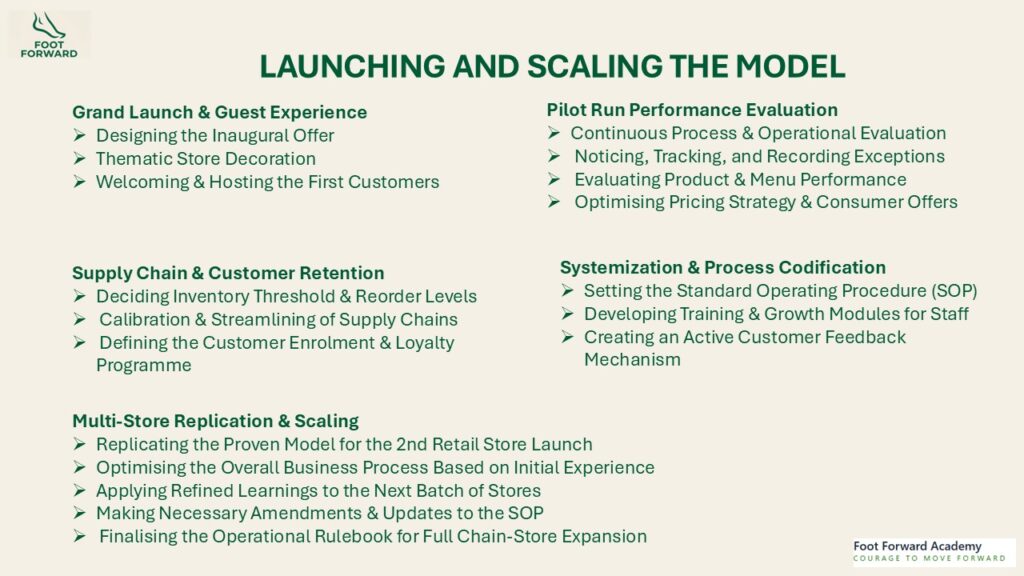
Som thought, with the help of my relatives, friends, and their network, I can expand it quickly.
A polite cough from Vishnu Priya informed Som that they were back.
She smiled and said, “Hey Som, indulged deeply in your task?”
Som replied, “Yes. I found the process is simple for chain stores. Success brings success. What risk was Mr. Singh talking about?”
Vishnu Priya smiled.
“Ohk!!! Have a clue. Let’s look at it this way. At every step in life, you can fall. Similarly, risks can be called out at every step.”
Som took a deep breath.
“You mean selection of the wrong location, poor site selection, cannibalisation of sales, inefficiency of the team to operate, local competition, idea replication under another name by a team member, or copying of SOPs, incorrect launching, or marketing failure?”
Vishnu Priya replied, “Great going, Som.”
Mr. Singh added, “Yes, but it is much wider and more complicated than what you shared.”
Som looked puzzled.
“Much wider? It does not look like that.”
Mr. Singh responded, “Where is digital risk, technology change, cash trap, legal sanctions, and many more?”
Som replied, “During the initial stage, those would have already been taken care of and a successful model created. Post that only expansion should happen. I still believe once you learn the success of a couple of retail stores, expansion becomes easy.”
Citibank in India
Mr. Singh spoke, “Let me share one case. It is about Citibank’s success in India. The risk associated is one of its own kind.”
Som responded quickly.
“Citibank is a premier global financial services institution. It is the primary U.S. banking subsidiary of Citigroup. They operated in more than 90 countries. Now tell me, can they fail in India?”
Then he added confidently,
“They should not fail anywhere in the world.”
Mr. Singh smiled.
“I like your confidence. Now listen.”
“They entered India in 1902, revolutionised the banking industry, but by 2022 had almost exited India under business stress.”
Som interrupted.
“Under stress?”
Mr. Singh continued,
“They had years of experience running banks in several countries. They entered India with a big bang. They became dominant in the credit card category and brought innovative concepts like Relationship Manager and Citi Suvidha.”
Som responded,
“So they might have quickly become a famous brand in India and accepted by all.”
Mr. Singh nodded.
“They kept it premium, limited to selected consumers and geography. Hardly had 35 branches.”
Som was surprised.
Mr. Singh continued,
“Whereas Indian banks reached the masses. For example, SBI had more than 3,000 branches. They replicated expertise and squeezed the market.”
“Citibank could not go to the masses with their premium retail banking image. Secondly, they did not want to tarnish their global image by diluting the premium positioning. They realised the return on allocation was lower in a few countries. India was one of them. So, they decided to sell and move out.”
Vishnu Priya softly pitched in,
“This is a classic case of masses versus premium. They struggled because premium customer density is lower in developing countries. The market to operate in was drastically different. One style cannot fit all geographies.”
Som responded thoughtfully,
“They experimented in many markets. They closed in a few and continued in others globally. A few selections will always be wrong. You cannot have 100% hits.”
Mr. Singh replied,
“A couple of branches incurring losses — would that impact your entire chain? Retail is capital intensive. Closure of a few branches can impact brand image and disturb the entire ecosystem.”
Som looked dissatisfied with Mr. Singh. He turned towards Vishnu Priya with scepticism.
She calmly said,
“We are not killing your enthusiasm, Som. We are making you more informed.”
Rise & Fall of Subhiksha Retail
Mr. Singh continued,
“To your point, Som, let me share the story of Subhiksha Retail.”
“Subhiksha Retail started in 1997 with a single store in Chennai. The concept was deep discount, no-frills stores with high store density in each area.”
“They succeeded in Chennai and expanded to more than 120 stores by 2006 across South India.”
“They then decided to expand into regions like NCR, Mumbai, Gujarat, and others. But they failed to manage supply chains, control pilferages, and operations.”
“The overheads increased faster than sales. Expansion was funded through banks and short-term loans. Dues had to be paid from profits earned by South stores.”
“Gradually, they fell into a cash-flow trap. Banks froze the accounts.”
“In 2009, just three years after massive success, all 1,600 stores shut within a short span. The company went into liquidation with huge losses.”
Som looked slightly confused.
He felt that facts were not completely supporting the theory. Only ingredients do not make a great dish. It is something more — maybe execution.
He spoke with caution.
“I would take a cautious call for AHLAD expansion. I will make every store profitable before launching another. I have noted training and development of the team. I will depute trustworthy team members for smooth operations, controlling discrepancies, and pilferages.”
Mr. Singh smiled.
“Som, you are taking it lightly.”
Som became curious.
“Please share your thoughts.”
Mr. Singh asked,
“Have you heard of Borders Books?”
Som shook his head.
Mr. Singh continued,
“Borders was an American retail chain — books, music, movies. At its peak, they operated more than 1,200 stores worldwide. Customers loved it. The brand had soul and strong presence.”
Som asked,
“So what happened?”
Mr. Singh replied,
“In 2001, they outsourced their online book sales to Amazon. Their thought process was simple — we are a physical experience brand, let someone else handle the digital side.”
“They handed their future to a competitor and called it a strategy.”
Som reacted immediately.
“That sounds like a blunder.”
Mr. Singh nodded.
“Yes, it was.”
“Amazon learned every customer’s buying habits, preferences, and price sensitivity. Borders remained blind to its own customers.”
“When digital shift accelerated, Borders had no relationship with its own customers. Stores were full, but the brand was hollow.”
“By 2011, every single store had shut. Around 19,000 employees lost jobs overnight.”
Som looked disturbed.
“This is very saddening. But I would not make this mistake. AHLAD will have its own digital connection with customers.”
Vishnu Priya responded,
“Som, do you see the deeper point here?”
“When AHLAD grows to twenty stores, fifty stores — each store will generate its own data. Customer preference by area. Peak hours. Best-selling items. Seasonal demand.”
“If you do not build the ability to read this data centrally, every store becomes an island. You will be managing noise, not a business.”
Som sat quietly for a moment.
Mr. Singh continued,
“Borders made another mistake. They overinvested in large premium store formats. At the same time, real estate costs were peaking. Fixed costs ballooned.”
“When revenue softened even slightly, the whole structure collapsed.”
“Som, in a chain, even a small dip in revenue can make fixed cost your enemy.”
Som once again looked at his notepad.
Oh, it may not be as easy as it first appeared. It has multiple challenges. All cannot be captured in one go.
Still, he could correlate that a few mistakes due to local, geopolitical, or any other reasons could whitewash the entire effort of establishing a brand.
He looked at Mr. Singh.
“Why don’t we find a way to safeguard against losses and amplify the growth model?”
“Fantastic,” Vishnu Priya responded.
“You are thinking like an entrepreneur. Smart for your age and exposure.”
How do brands balance this risk?
Find out in Part 6 as we unlock the structural secrets of shared retail spaces and alternative expansion models.