
Som’s Retail Journey | Part 6
FRANCHISE BUSINESS MODEL
Jun 04, 2026 | 8–9 min read
Som had been thinking deeply since his last discussion with Vishnu Priya and Mr. Singh.
The café model of AHLAD was slowly taking shape in his mind — the logo, the menu, the warmth he wanted customers to feel the moment they walked in.But now, another question troubled him:
“If AHLAD works in one location, how do I grow it without breaking it?”
He already knew organised retail format expansion was not simply about opening more stores. Every format came with rewards, traps, and hidden costs. One wrong decision could turn a dream into a liability.
That was why he met Vishnu Priya and Mr. Singh again — this time at Tim Hortons, inside one of the city’s busier malls.
Som arrived early. The mall had just begun buzzing. Families drifted past shop windows. Young professionals sat in corner cafés, laptops open, coffees half-finished. Retailers were pulling up their shutters, slowly waking the floor to life. He spotted Mr. Singh already seated — notebook open, coffee in hand, completely unhurried.
Before any formal beginning, Mr. Singh glanced at Som’s notebook.
“Tell me,” he said. “What is the biggest risk with the chain store retail format?”
Som considered it. “It is capital intensive. Every store needs investment — rent, interiors, manpower, inventory, operations, marketing. If the stores do not perform, you lose many, simultaneously.”
Mr. Singh nodded. “Exactly. That is why expansion in retail is thrilling — and dangerous in equal measure.”
Why Friends and Family First? Trust, Alignment, Local Execution
Som asked, “Sir, in our last conversation, you mentioned that if I ever expand AHLAD, I should first involve friends, family, or people close to me. Can you help me understand why?”
Mr. Singh set down his coffee.
“Retail expansion is not only a capital decision. It is a question of trust, alignment, and local execution.”
He paused. “Do you remember the Subhiksha case we discussed?”
Som nodded. “Pilferage. Operational leakage.”
“Correct,” Mr. Singh said. “When stores multiply, monitoring becomes genuinely difficult. If the people running your outlets do not share your values — your standards, your intent — problems do not just appear. They multiply silently.”
He continued. “People close to you — friends, family — often understand your vision better than a hired manager ever will at the beginning. They understand what you are trying to build. They understand local customer behaviour. They do not just manage a store. They protect your idea.”
Som wrote carefully in his notebook:
Retail expansion = trust + alignment + local understanding.
Mr. Singh glanced at it and smiled.
“Interestingly — the very concerns you just raised — capital, control, pilferage, local trust — these are precisely what gave birth to another retail format entirely.”
Som looked up. “Which format?”
Mr. Singh said it simply:
“Franchise Retail.”
Organised Retail Format: Understanding Franchise Retail
“Suppose” Mr. Singh began, “AHLAD becomes successful. One café. Loyal customers. A clear identity.”
“Now suppose instead of investing your own money to open the next outlet — someone else invests the capital. They take on the financial risk. But they operate the outlet using your brand, your systems, your standards.”
Som’s expression shifted. “They spend the money — but use my brand?”
“Exactly,” Mr. Singh said. “That is franchise retail.”
The structure:
- Franchisor (brand owner): provides brand name, operational systems, training, SOPs, and quality standards.
- Franchisee (local entrepreneur): brings the capital, runs the store, hires staff, and handles local execution.
“So expansion becomes faster?” Som asked.
“Faster and significantly less capital intensive for the brand,” Mr. Singh confirmed. He paused deliberately.
“But remember — every retail format solves one problem while creating another.”
Som laughed. “So what does this one create?”
“Mr. Singh answered without hesitation. “If a franchise outlet delivers a poor customer experience — a bad product, rude staff, an unclean space — the customer does not blame the franchise owner. They blame the brand.”
Barista
Years ago, coffee chains wanted rapid scale. Brands like Barista explored models where local entrepreneurs became partners in building the brand’s footprint.
- Benefit: faster reach, lower capital burn for the brand.
- Challenge: maintaining consistency. “One bad cup of coffee,” Mr. Singh said, “or one indifferent interaction with a customer, can quietly erode what took years to build.”
Lesson: For a café brand like AHLAD, consistency is existential. Think deeply before the first expansion, not after.
Adidas
“Can one company directly own and operate thousands of stores across dozens of cities and multiple countries?” Som shook his head. “Impossible.”
“Precisely. Which is why partner-led and franchise models become essential at scale.” Even global brands rely on regional partners who understand local mall economics, customer preferences, and on-ground realities.
“Retail is local,” he said simply. “Even global brands need local intelligence.”
Lesson: Franchise expansion works best when you pair your system with local execution strength.
Tanishq
“Jewellery retail runs on trust above everything else. One inconsistent experience — a questionable weighing, an unhelpful salesperson — and that trust fractures.”
So Tanishq built a system before expanding: detailed operational standards, rigorous training, store design norms, regular audits.
“The brand did not simply give people permission to sell jewellery under their name. They built a replicable experience.”
Lesson: Franchise is not just a license. It is a system that must work even when you are not in the room.
Organised Retail Format: Understanding Franchise Ownership Models
Vishnu Priya quietly joined them, her eyes immediately drawn to the Card layout Mr. Singh had sketched in his notebook. The context became clear, and she seamlessly stepped into the discussion as though she had been part of it from the very beginning.
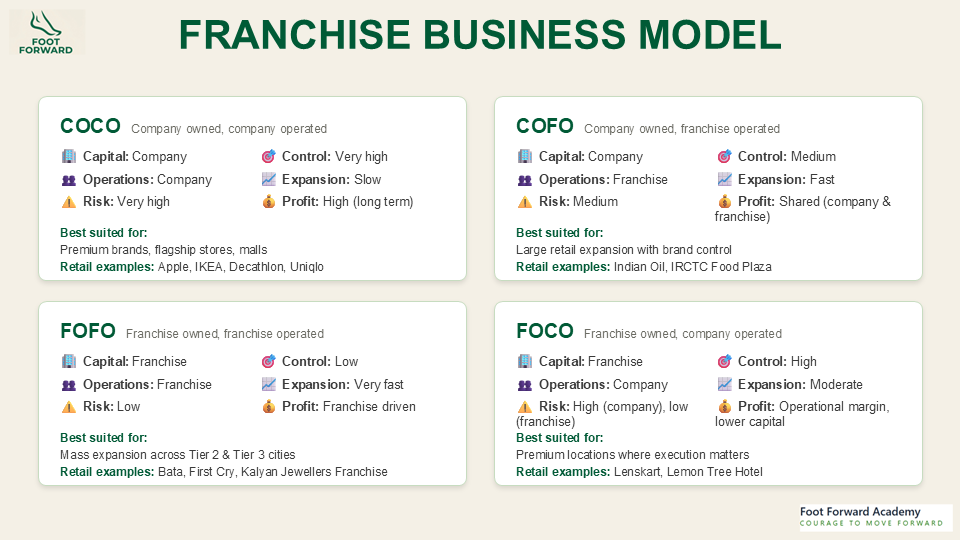
Vishnu Priya asked, “Which one would you prefer for your Café AHLAD?”
Som replied, “This seems to be very confusing.”
Vishnu Priya said, “Still, give it a try.”
Som said, “I would like to understand the card layout in depth before giving it a try.”
McDonald’s (quick-service restaurants, global):
Mr. Singh smiled. “Let me tell you something interesting, Som. When Ray Kroc started building McDonald’s, he wasn’t just thinking about selling burgers. He was thinking about how to protect the brand while expanding it. Every new restaurant had to deliver the same experience, whether it was in one city or another.”
He continued, “Then he made a brilliant move. Instead of only franchising the restaurants, he started owning the land on which many of those restaurants were built and leased it back to the franchisees. Think about it—if a franchisee failed to meet the brand’s standards, McDonald’s could replace the operator without worrying about losing that prime location.”
Mr. Singh took a sip of his coffee before continuing. “That single decision gave McDonald’s tremendous control over its expansion. One restaurant became hundreds, then thousands. Today, the brand operates in more than 100 countries, with most of its restaurants run by franchise partners. Yet, despite the scale, McDonald’s has managed to maintain remarkable consistency.”
Vishnu Priya spoke, “Som, I expect you have mapped the two formats discussed above in this case.”
Som thought, “COCO & COFO models.”
Vishnu Priya acknowledged the same with a smile.
Tanishq (jewellery, India):
Mr. Singh: Like McDonald’s, Tanishq initially expanded through company-owned stores to establish customer trust, operating standards, and service consistency.
Once the model matured, it accelerated expansion by partnering with franchisees. The franchise partner invested in the store infrastructure, while Tanishq retained strong control over pricing, inventory, merchandising, technology, and the customer experience.
This allowed the brand to expand rapidly into Tier 2 and Tier 3 markets without compromising the trust that jewellery retail depends upon.
Som said, “Oh, the start is the same, but the progression is with the FOFO model.”
He continued, “It means you cannot excel with the COCO model. It is not a sustainable model.”
Vishnu Priya spoke, “No, Som, do not reach any conclusion so quickly. You have to research these models. Get in-depth for a better understanding.”
Som said, “But I feel it has high risk and high investment. How can anyone succeed when every store has 100% of your stake?”
Mr. Singh said, “Brands like ZARA and Westside are the best examples to prove your statement wrong.”
Zara is a globally successful fast-fashion brand, and so is Westside in India. They operate as COCO stores, and they are second to none in retail across expansion, growth, profit, and customer experience.
Vishnu Priya smiled. “Exactly, Som. Don’t look for the best model. Look for the one that best fits AHLAD’s vision, investment capacity, operational involvement, control, and growth plans. Every company chooses its organised retail format based on its own strengths, challenges, and business priorities.”
Som started recapping the organised retail format discussion in his notebook.
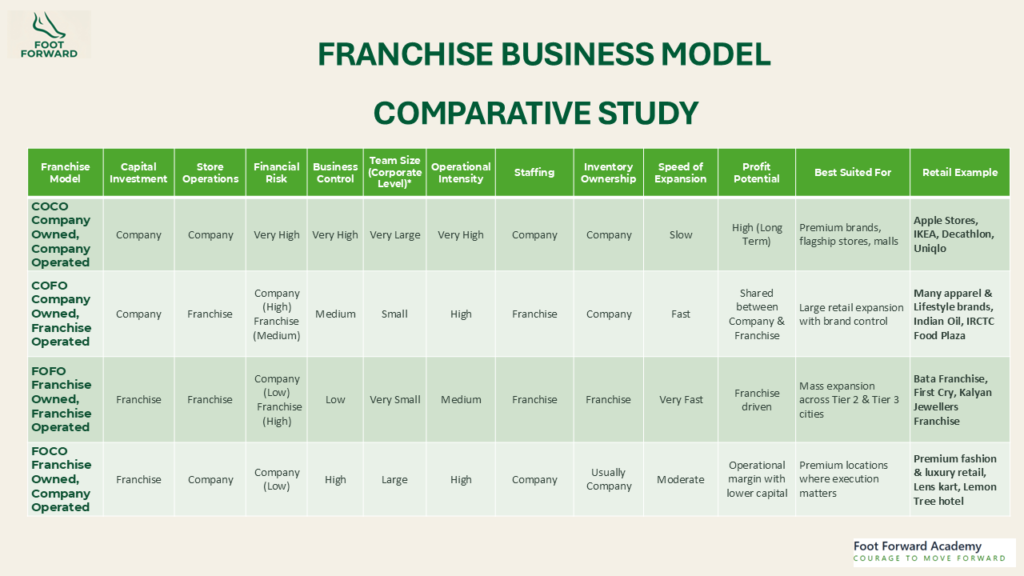
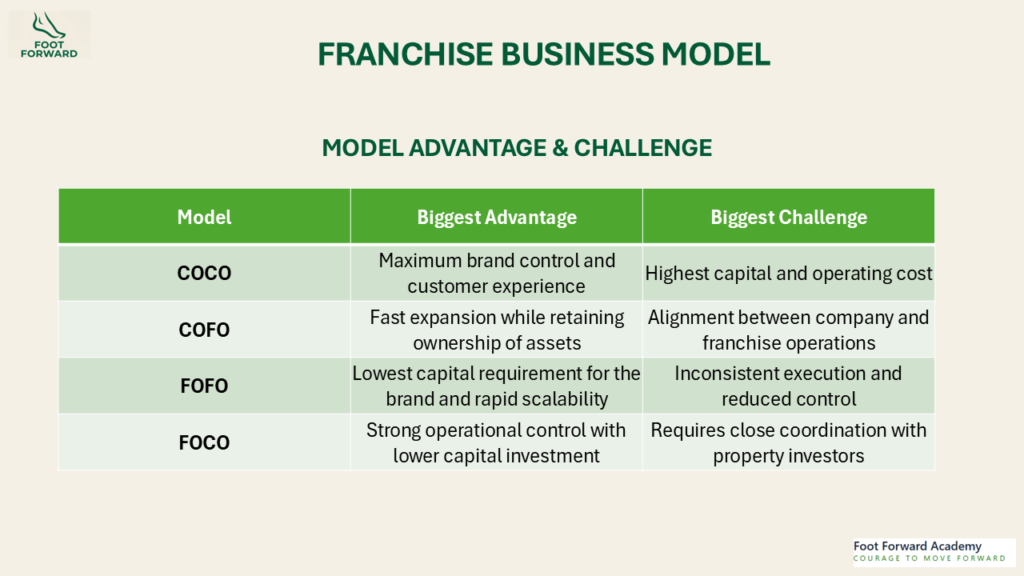
Som asked, “How did McDonald’s, Domino’s, and Pizza Hut expand globally in such a short span of time? What did they do differently?”
Mr. Singh smiled. “Yes, Som. One of the biggest reasons is the Master Franchisee Concept.”
Som looked surprised. “Master Franchisee Concept?”
Vishnu Priya smiled. “You’ll have to wait until our next meeting to understand the Master Franchisee Concept. Meanwhile, use today’s discussion to decide which ownership model best suits AHLAD.”