
Som’s Retail Journey | Part 7
MASTER FRANCHISE BUSINESS MODEL
Jun 12, 2026 | 8–9 min read
Act I: Defining the Master Franchise Business Model
Som speaks, “Master Franchise means…”
“Mr. Singh, before going ahead, what’s on your mind right now? What are you thinking regarding the AHLAD expansion?”
Som says, “I am thinking of launching our first company-owned and company-operated (COCO) café.”
“Nice!” Mr. Singh says. “Do you have prior experience? What would you do first, then second, third, and so on?”
“I will visit existing cafés and ask about them,” Som replies. “I will meet café owners to understand the process, the challenges, and the ways they handle them.”
Mr. Singh asks, “Is it that easy? Why would people entertain you? Why would anyone share their secrets to success? Going about it this way, in what timeframe do you think you would be launching the first store?”
“I know it will take time, but yes, I can get the information,” Som says.
Mr. Singh responds, “Great! But this is something you could have done already. Why then have you approached Vishnu Priya?”
Something clicks in Som’s mind. Consultation.
Building on others’ expertise saves time, improves decision-making, reduces the chance of loss, and increases the success rate.
Mr. Singh says, “Yes, Som. You should seek café consultant guidance from Vishnu Priya. A café consultant will give you the blueprint to launch your first café.”
Som asks with surprise, “Blueprint?”
“Yes,” Mr. Singh answers. “It will be a detailed plan of action with a proper sequence and timeline.”
Som speaks up, “But that will be their plan. They will not be following my dream.”
Mr. Singh explains, “A consultant always gives direction to your ideas and thoughts, optimizing them. So, the blueprint will simply be a curated version of your dreams.” He continues, “See, we discussed retail, and AHLAD is your brainchild. Now we are working on it, yet nothing is finalized.”
“Yes, that looks fine,” Som agrees. “Based on the consultant’s guidance and my own research work, I will open the first café. I will make it successful first.”
Mr. Singh asks, “Will you launch it alone?”
“No, I will recruit people,” Som says.
Mr. Singh probes further, “Whom would you be recruiting, how will you reach them, and what skills and experience should they have?”
Again, Som replies, “I will hire from successful cafés. They will perform the tasks.”
“Under whose supervision? How will those tasks be evaluated?” Mr. Singh asks.
Som speaks up, “The consultant will help me with this task.”
“I like your confidence,” Mr. Singh says. “What next?”
Som speaks, “We will launch the first store and make it successful. After that, we will open a few more stores. Once I have enough experience, I will go for franchise stores. My team can then guide them and save them from all the trouble we went through.”
Mr. Singh asks, “So you believe that launching a few stores will make your team capable of running things more efficiently and flawlessly in the future?”
Som speaks, “Yes, because they will have the experience by then. They can supervise the franchises.”
Mr. Singh asks, “Would you be opening just a few franchise stores?”
“No, multiple,” Som says. “I want to make it a big brand.”
Mr. Singh points out, “In that case, you would need to train many franchisees and supervise them daily.”
“Yes, definitely,” Som answers. “We can even ask our best franchisees to open multiple cafés. Running one or two cafés will give them the experience to expand quickly. They will have the team required to do it fast.”
Mr. Singh says, “Fantastic! That means they have mastered the work. So, you will make them a Master Franchisee. You will grant them multiple cafés in their designated areas.”
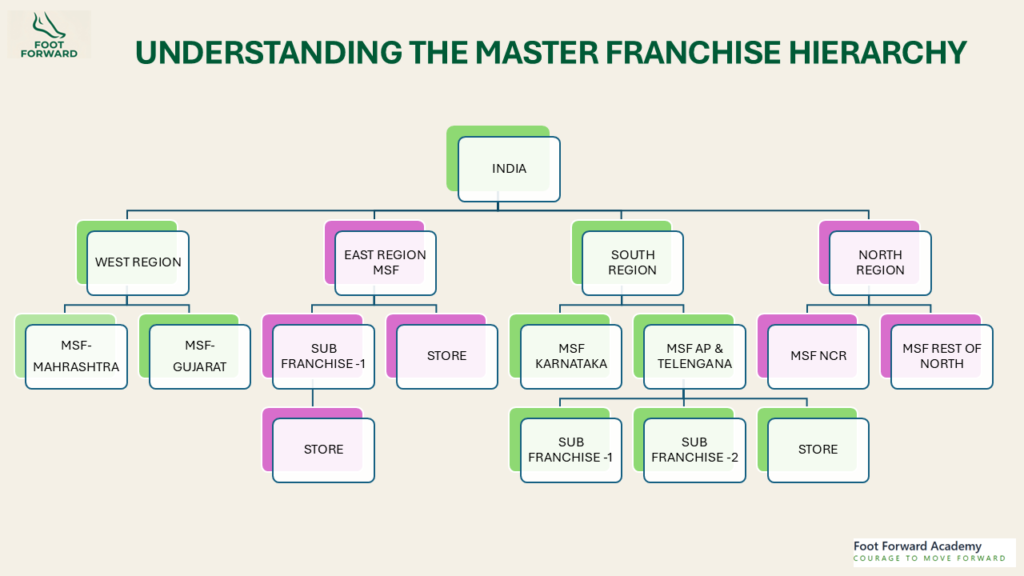
“Yes, why not?” Som agrees.
Mr. Singh explains, “This is exactly the Master Franchise concept, Som. Mastery over the business model enables them to become a Master Franchisee for a specific area for a brand.”
Act II: Brand Examples and the Power of the Model
Brands Amplifying the Master Franchise Concept
The Domino’s Pizza Inc. A US brand launched in 1960 that now operates in more than 90 international markets. The brand operates on an international master franchise strategy. They utilize multiple Master Franchisees:
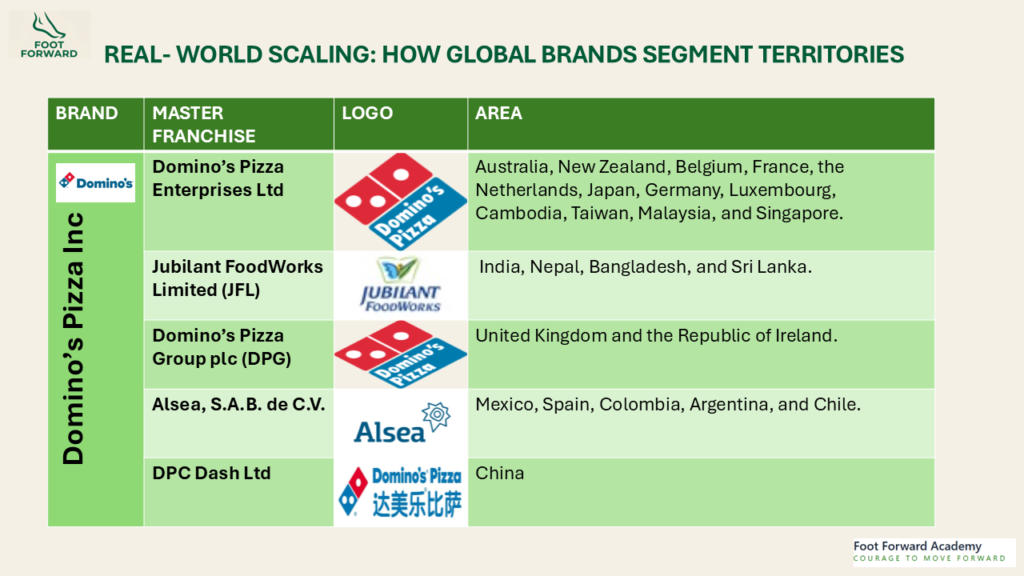
- Domino’s Pizza Enterprises Ltd (DPE): The absolute largest international master franchise in the Domino’s system. They operate in Australia, New Zealand, Belgium, France, the Netherlands, Japan, Germany, Luxembourg, Cambodia, Taiwan, Malaysia, and Singapore.
- Jubilant FoodWorks Limited (JFL): Jubilant FoodWorks holds the exclusive rights to operate the Domino’s brand in India, Nepal, Bangladesh, and Sri Lanka.
- Domino’s Pizza Group plc (DPG): They are appointed for the United Kingdom and the Republic of Ireland.
- Alsea, S.A.B. de C.V.: The territory under their control comprises Mexico, Spain, Colombia, Argentina, and Chile.
- Other notable mentions include: DPC Dash Ltd for China, DP Eurasia N.V. for Turkey, Russia, and Eurasia, and Cheong-oh DPK Co., Ltd. for South Korea.
Similarly, Burger King—owned by its parent company, Restaurant Brands International (RBI)—has mastered this concept. Here is a list of their major Master Franchisees and the territories they operate in:
- Restaurant Brands Iberia (RB Iberia): Spain, Portugal, and Andorra.
- TAB Food Investments (TFI): China and Turkey.
- Restaurant Brands Asia (RBA): India and Indonesia.
- Olayan Group (Hana International): Middle East & North Africa (MENA)—including Saudi Arabia, UAE, Kuwait, Qatar, Bahrain, Oman, Egypt, and Lebanon.
- Hungry Jack’s Pty Ltd (Jack Cowin): Australia.
Mr. Singh speaks, “Som, these are examples of international Master Franchisees. In India, brands like Skechers, Adidas, Nike, and Levi’s operate on a similar concept. Their franchisees open multiple stores and operate them. Although they don’t always have exclusive territorial rights, the operational model for the stores is the same.”
Master Franchise Power
Mr. Singh continues, “We have seen Jubilant FoodWorks Limited (JFL) act as the Master Franchise for Domino’s India. Their expertise and operational efficiency eventually helped them fetch other brands for their portfolio, like Dunkin’ Donuts and Popeyes.
Retail veterans like the Apparel Group and Reliance Brands Limited have similarly secured multiple master franchises for the Indian market. Once a master franchisee is well-developed by one brand, they can become the best fit for others. This is the amplifying power of the model across the entire retail industry.
So, it’s a win-win situation for both parties. Increasing the number of brands in a master franchise’s portfolio increases their negotiation power, improves operational efficiency, and reduces risk. A diverse portfolio improves the learning curve of the MasterFranchise’s team, and they gain access to better resources. Therefore, for the AHLAD expansion, you can look for existing retail partners.”
Som asks Mr. Singh, “Can you share a detailed example of a brand working on a similar model in India?”
Mr. Singh replies, “Levi’s operates very close to this model. They have nearly 30 partners across India. Their prominent partners include SSIPL for the NCR, Westwind in the North region, Saffron Lifestyle Traders Pvt. Ltd. for Gujarat, Mitul Enterprises in Mumbai and Pune, and Pearl Fashion & Balaji Retail in the South. They have also appointed a couple of regional Master Franchisees to expand into Tier-1 and Tier-2 cities, like Chinnamani Garments for Goa, Vidarbha, and upcountry Maharashtra.
A cluster of 15 to 25 stores per Master Franchisee is easy for a brand to manage. The stakes aren’t unsustainably high for any single partner, and their geographic reach is kept focused for better efficiency. Local expertise has worked incredibly well for them.”
Act III: Balancing the Benefits and Risks
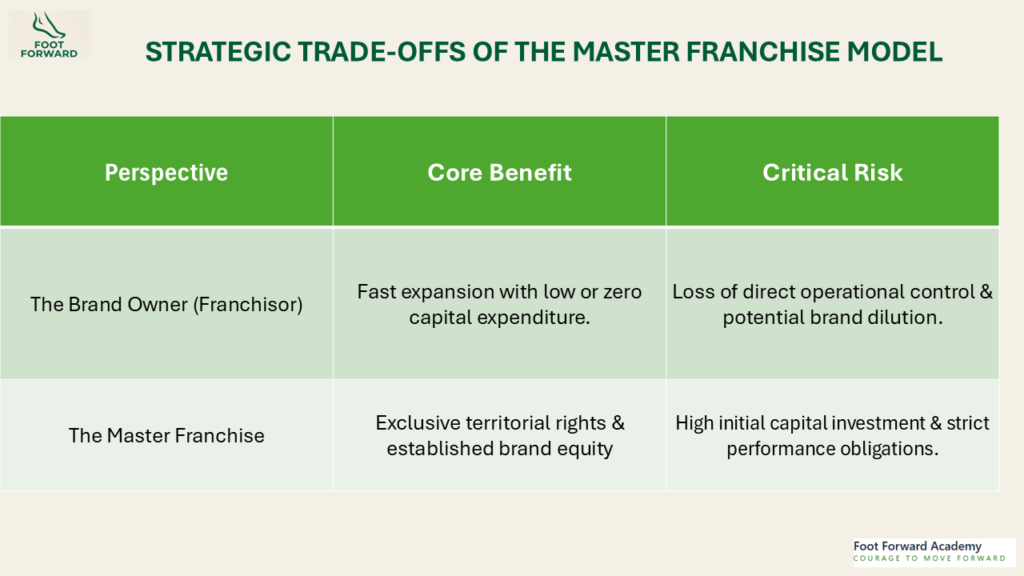
Som summarizes the thought: “So, the Master Franchise (MSF) model plays the role of a catalyst in successful expansion. It offers multiple advantages for both sides.”
For the Franchisor (The Brand Owner)
- Fast expansion
- Low or no capital investment
- Local market expertise (regulatory know-how, supplier relationships, and consumer insights)
- Faster scaling
- Reduced legal complexity
- Steady royalty income
“I just have to appoint a few good franchisees, train them, and ensure they deliver a profit; they will then open multiple stores across the nation. I can even look toward global expansion later.”
For the Master Franchisee
- Established brand equity
- Proven business model
- Sub-franchising rights
- Territorial exclusivity
- Portfolio leverage
- Localization flexibility (menus, pricing, store formats)
- Shared risk
- Faster problem resolution
Mr. Singh cautions, “Yes, Som, but every model has its own challenges.
McDonald’s granted the developmental rights for North and East India to Connaught Plaza Restaurants (CPRL). Over time, they fell into disputes over governance, royalty payments, compliance, and operations. They eventually had to terminate the agreement, which severely disrupted the brand’s presence in that region of India.”
He continues, “A Master Franchisee should never dominate the brand itself. Non-adherence to core values will dilute your brand image. Ideally, a single Master Franchisee should hold a relatively small portion of the brand’s total revenue to minimize the fallout if the relationship collapses.
In India, brands like Levi’s, Nike, Adidas, Asics, and Skechers follow an operational concept highly similar to a master franchise. They don’t always grant exclusive territorial rights, but the operational execution is identical.”
Mr Singh adds, “7-Eleven appointed the Future Group as their master franchise in India. However, the Future Group became financially unstable and struggled to expand the brand. The 7-Eleven journey was put on hold entirely due to the fall of the Future Group. This case gives a classic insight into the extreme importance of selecting the right Master Franchisee.”
Som’s Risk Summary
For the Brand Owner (Franchisor):
- Loss of direct control
- Brand dilution risk
- High exit barriers
- Reduced revenue share
- Information asymmetry (gaps in communication/data)
For the Master Franchisee:
- High capital investment
- Strict performance obligations
- Limited creative freedom
- Heavy dependency on the parent brand
Systemic Risks:
- Cultural and regulatory misalignment
- Succession risk
Som speaks, “Oh, so rapid expansion, the unpredictable success rate of a launched store, and high entry and exit barriers can dilute the brand image—or it may even push a brand to the brink of collapse. A few company-owned, company-operated (COCO) stores will not be able to compensate for such massive losses.”
Som Asks, “Can we have the best of all models instead? Low or no capex, working with a seasoned retailer, operating out of well-known existing stores, quickly scalable, and easy to exit?”
He takes a pause,” is it looks like Wishlist?”
Mr. Singh: “It isn’t a wish list anymore. Entrepreneurs have already evolved a format that comes remarkably close — the Concession model, also known as Shop-in-Shop.”
Som goes quiet for a moment, then smiles, “So AHLAD could sit inside a store that already has the footfall, the trust, and the location — without me spending a rupee on real estate?”
Mr. Singh: “Now you’re thinking like a retailer, Som. But before you get excited — this model has its own fine print. Let’s unpack it next.”