
Som’s Retail Journey | Part 8
CONCESSION RETAIL FORMAT
Jun 19, 2026 | 8–9 min read
A Conversation at the Food Court
Som was heading towards the mall’s food court, with thoughts of the Concession Retail Format on his mind. Mr. Singh was already at the food court. He welcomed Som, and they settled down.
Mr. Singh: “What would you have, Som?”
Som (jokingly): “I would have only the Concession Retail Format on my plate.”
Mr. Singh ordered two dosas for them.
Mr. Singh: “See how buzzing it is. Can you tell me why?”
Som: “Look at the variety of food. It has something for everyone, and the best options from every category are available. It reminds me of the village Chat Chowpatty. It was the best place to enjoy a variety of food for every type of taste palate.
One person could enjoy the best of every cuisine. Look around—people from every age group are here. It reminds me of my village. Adults, kids, teenagers, and senior citizens all have a wide variety of choices. Vegetarian, non-vegetarian, sweet, spicy—everything is available instantly.
See, many groups with people of different ages and genders are enjoying food from different counters. No one has to compromise on their choice.”
Mr. Singh smiled. “Don’t you think a fine-dining restaurant would provide a better experience?”
Som: “Yes, but this is faster. Different types of food are available, it’s a little more economical, and even local food counters are available.
Most of the food options are displayed right in front of you. You can see the food before deciding. You get to enjoy the best of all worlds.”
Mr. Singh: “Do you think it can be made even better?”
Som: “Yes. If there were a single billing option for food purchased from all the counters, customers wouldn’t have to stand in multiple queues.
Since the seating area is common, a better seat allocation system could also be introduced. People should receive proper order updates instead of repeatedly guessing and checking whether their order is ready.”
Mr. Singh: “That’s why customer feedback is such a powerful tool for improvement.
So, what you mean is that one roof, one process, and one command for all the counters would make the customer experience even better.”
Som: “Exactly.”
Mr. Singh: “This is exactly what the Concession Retail Format is all about.”
Concession Retail Format
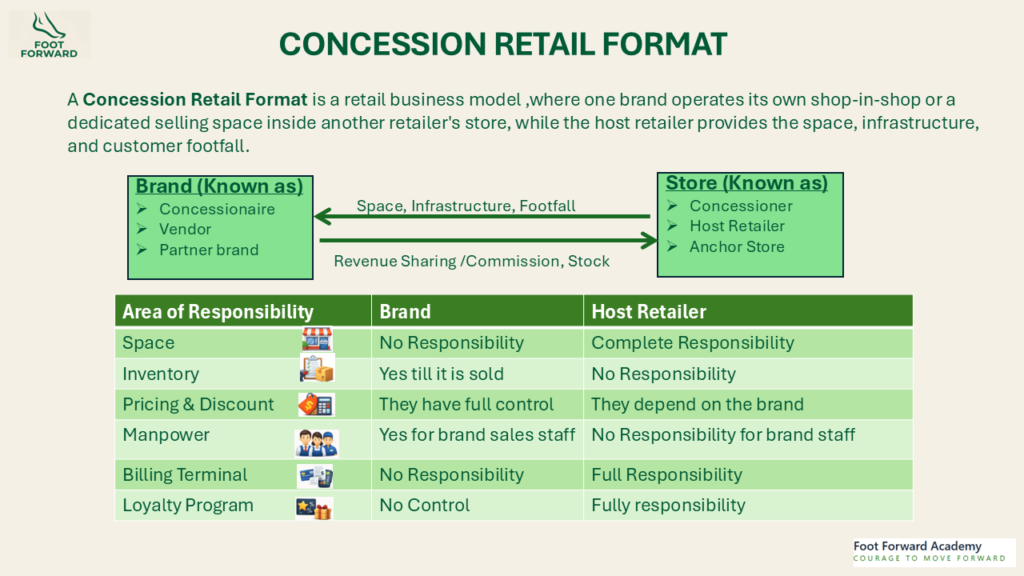
A Concession Retail Format is a retail business model where one brand operates its own shop-in-shop or a dedicated selling space inside another retailer’s store, while the host retailer provides the space, infrastructure, and customer footfall.
Lifestyle Stores
Mr. Singh: “You know, Som, this concept is perfectly exemplified by Lifestyle stores. They are family stores offering apparel, accessories, luggage, and beauty products. A separate department is created for each category. That’s why they are also known as Department Stores.
These departments offer products for different occasions and for every member of the family.
In the men’s department, you will find formal wear, casual wear, ethnic wear, and athleisure products.
Within each category, a dedicated space is allocated to different brands. For example, when you visit the men’s casual section, you will find international brands like Jack & Jones, Levi’s, and UCB, domestic brands like Rare Rabbit, along with Lifestyle’s in-house brand Fame Forever.
This model is replicated across almost every section and department of the store. There may be exceptions in a few categories, such as beauty, where almost all the brands are external.
The perfect blend of men’s, women’s, boys’, girls’, home décor, footwear, and beauty categories attracts customers to the store.
These are large stores that house multiple brands under one roof, operate under centralized control, and follow the same Standard Operating Procedures (SOPs). Hence, they are also known as Large Format Stores (LFS).
USPA’s Concession Model in Lifestyle
This is one of the strongest channels in organised retail. Let’s understand this concept through the brand USPA in an LFS.”
Mr. Singh: “USPA is a well-known brand in India and a leader in the men’s knitwear category. It operates through multiple retail formats such as COCO and FOFO. It also has a strong presence in Large Format Stores like Lifestyle, Shoppers Stop, Pantaloons, and Centro.
Lifestyle has built a strong brand image and a loyal customer base, generating significant footfall in its stores.
USPA gets exposure to every customer visiting that department. At the same time, the presence of USPA and other like-minded brands enhances the store’s assortment and attracts more customers.
The store setup and day-to-day operations are managed by Lifestyle. USPA installs its fixtures in a designated area and provides the merchandise and manpower. The promoter ensures that the brand guidelines are followed while assisting customers. Although employed by the brand, the promoter also contributes to Lifestyle’s overall customer experience.
In return, USPA pays Lifestyle an agreed margin /commission, or revenue share for the space, infrastructure, billing, and other resources provided. Since the investment required for setting up the counter is relatively low, the brand gains access to quality customers, high visibility, and a strong opportunity to generate sales.”
Som: “Oh, great! This is much closer to the COFO model.”
Understanding COCO, FOFO & Concession Retail Format
Mr. Singh: “Yes, you can say that. Let’s look at the comparison below for a better understanding.”
| Model | Inventory Owner | Staff | Store Owner | Pricing Control |
| COCO (Company Owned Company Operated) | Brand | Brand | Brand | Brand |
| FOFO (Franchise) | Franchisee | Franchisee | Franchisee | Usually Brand-guided |
| Concession | Usually, Brand | Usually, Brand | Host Retailer | Brand |
T BASE in Concession Retail format
Som: “As you said, USPA is a well-renowned brand. It has been given space in LFS because it already has stores and an established customer base. But how can this format help launch a new brand without opening its own stores?”
Mr. Singh: “Good question.”
“Let’s go to the store.”
At the store, Mr. Singh pointed towards the brand T BASE.
“Look at the space allocated to T BASE. It is displayed on Lifestyle’s fixture. T BASE has not installed its own dedicated fixture.”
Mr. Singh: “Som, kindly check with the floor staff whether T BASE has its own promoter.”
Som spoke to the staff and returned.
Som: “They don’t deploy their own manpower. The products are sold either by Lifestyle’s staff or by brand promoters.”
Mr. Singh: “Exactly. That’s why the operating cost for T BASE is almost negligible. They simply supply the merchandise and pay Lifestyle a margin or commission.”
Som: “That’s true. But why would Lifestyle allocate space to them? They are not well known to customers, and it isn’t Lifestyle’s own product either.”
Mr. Singh: “Think about the food court again. It attracts customers because of the variety it offers. People visit a food court knowing they will have multiple choices. Even an unknown local food brand benefits from that footfall.
You must have noticed the fresh juice counter at the centre of the food court. It isn’t a famous brand, yet it performs well because it complements the overall offering.”
“Similarly, T BASE fits Lifestyle’s price proposition and product assortment. Now consider this—Lifestyle has more than 100 stores. Once T BASE signs an agreement with Lifestyle, it immediately gets access to all those stores.”
“T BASE gets quality customers, an opportunity to test its products, build brand awareness, generate sales, and eventually earn profits.”
Shop in Shop (SIS) :A Subset of Concession Retail Format
Som: “So, we have two options. First, to install our own fixture. Second, to display our products on the partner’s fixture. Both are forms of the Concession Retail Format.”
Mr. Singh: “True. The first option is also known as Shop-in-Shop (SIS). It is a subset of the Concession Retail Format.”
A Shop-in-Shop (SIS) describes the physical retail layout, whereas a Concession describes the commercial operating arrangement. Many concessions are implemented as shop-in-shops, but not every shop-in-shop operates under a concession agreement.
Mr. Singh continued, “Som, you can also check the girls’ apparel brand Peppermint. It is one of the leading brands in Large Format Stores. It has a strong presence in both Shoppers Stop and Lifestyle. With more than 100 counters, the brand has built a strong customer base and generates substantial revenue.”
Can AHLAD follow the same Strategy ?
Som: “But how would the Concession retail format be suitable for AHLAD, since it is a café?”
Mr. Singh: “Look at a few examples. IKEA has cafés and restaurants. Barnes & Noble in the USA has cafés. Shoppers Stop also operates cafés in some of its stores. Even Big Bazaar had cafés and restaurants in several locations.
In most Large Format Stores, the cafés are operated in-house. However, if you can crack the code and secure space in even a few stores, it can give a significant thrust to your business. Yes, it may look difficult, but it is certainly not impossible.”
Mr. Singh continued, “The same concept can also be applied to large-format salons, spas, gyms, and several other businesses. Even if the complete business cannot be accommodated, a few selected products or services can still be offered through this format.”
Benefits and Risks of the Concession Model
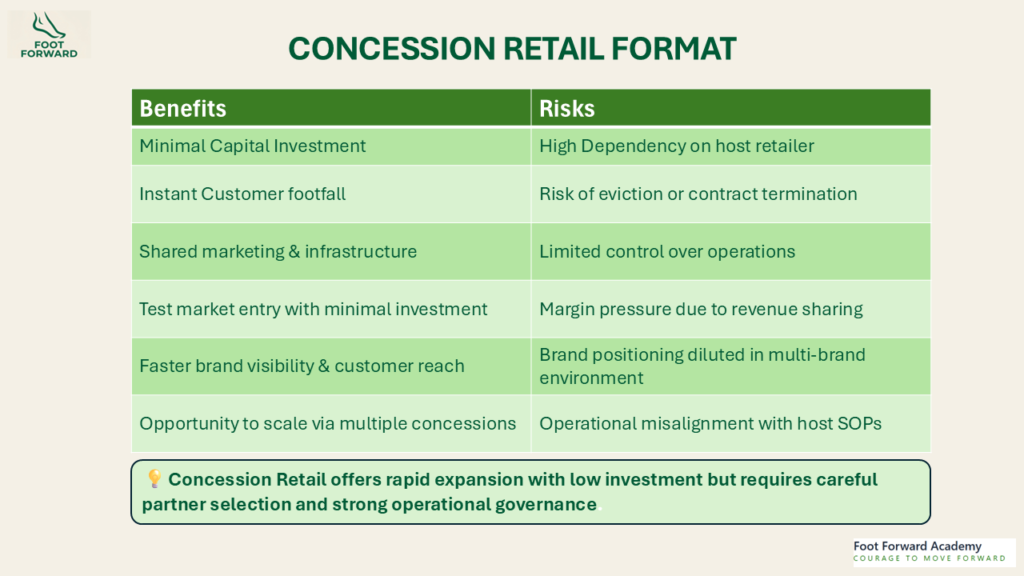
Som: “This seems like a cost-effective and quick way to grow. Why don’t all brands follow this model?”
Mr. Singh: “Because every retail format has its own challenges.
There are only a limited number of Large Format Stores to accommodate hundreds of brands. If another brand offers a better commercial deal, you may be asked to vacate your space. Once that happens, your market presence through that channel becomes negligible.
That’s why this format should be considered as one part of your overall retail strategy. It is an excellent way to grow and, in many cases, a smart way to launch a new brand. However, depending entirely on this format is not advisable.”
The Next Step in Retail Strategy
Mr. Singh: “A brand should have a presence across multiple retail formats. This enables you to target the right customer segment and position your brand effectively. It also helps you build your own customer base and successfully drive your STP strategy.”
Som: “What is the STP Model? These terms sound alien to me.”
Mr. Singh: “It simply means identifying the right Segment (S), Targeting (T) that segment, and Positioning (P) your brand accordingly. That’s what the STP Model is all about.”
Som looked curious. He wanted to learn more about the STP Model.
Mr. Singh smiled and said, “Sure, but we’ll discuss that another day. Until then, take another look at the different retail formats and continue refining AHLAD’s retail launch plan.”