
Som’s Retail Journey | Part 9
SEGMENTATION
Jun 26, 2026 | 8–9 min read
Why Every Customer Is Not Your Customer?
Som reached the mall early that evening. His thoughts swung between retail format for expansion and the Segmentation, targeting & positioning strategy, which was yet to be explored.
As he walked toward the food court, he saw Mr Singh already seated with a cup of tea.
Som sat down and spoke immediately.
Som: Mr Singh, I have finalised it. AHLAD should be launched with multiple retail formats to cater to everyone. Students, office people, families, tourists, mall visitors, children, senior citizens— everyone drinks tea or coffee. The bigger the customer base, the bigger the business.
Mr Singh smiled but did not respond immediately.
Mr Singh: Before answering, let us take a small walk.
They started walking through the mall.
The first stop was Starbucks.
People were sitting with laptops. Some were attending virtual meetings. A few were working on presentations. Nobody seemed in a hurry.
Mr Singh: What do you observe?
Som: Premium ambience, expensive beverages, working professionals, business meetings, students with laptops, and people staying for a long time.
They walked a little further and stopped at Chai Point.
The environment was completely different. Customers came quickly, ordered tea, coffee, snacks, and left within a few minutes. Many orders were being prepared for delivery.
Som: This crowd is different. It looks more functional.
Mr Singh: Correct. Now one last stop.
They stepped outside the mall near a busy road where a local tea stall was operating.
Auto drivers, delivery executives, security guards, shop staff, and commuters were drinking tea while standing.
Mr Singh: Same product category—tea and coffee. But are the customers the same?
Som paused for a few seconds.
Som: No. The product category is similar, but the people, spending capacity, purpose of visit, and expectations are completely different.
Mr Singh nodded.
Mr Singh: And that realisation is called Segmentation.
What is Segmentation?
Mr Singh drew a circle on a tissue.
Mr Singh: Imagine this circle is the entire beverage market of a city. Everyone inside drinks something—tea, coffee, juice, shakes, or snacks. If you try to sell the same experience to everyone, your communication becomes weak.
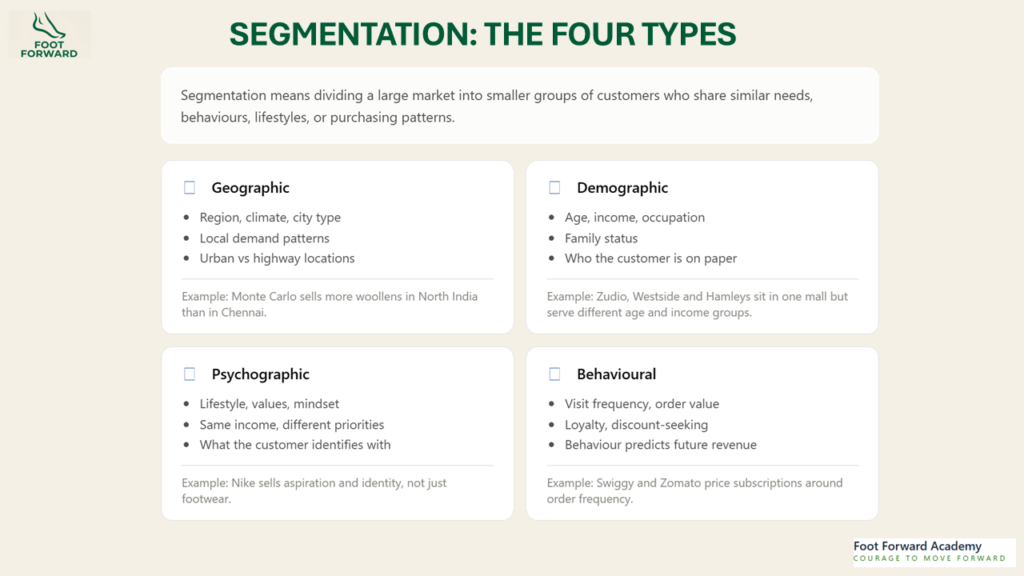
Segmentation means dividing a large market into smaller groups of customers who have similar needs, behaviours, lifestyles, or purchasing patterns.
Som: So, segmentation is not rejecting customers?
Mr Singh: Exactly. It is understanding that different customers expect different solutions.
The Simple Example–Segmentation
Mr Singh pointed toward three watch brands -Titan, Fastrack & Sonata. He asked him to spend time at the store.
Som replied after spending a couple of hours there.
Titan Watches are considered premium, affordable luxury. Working professionals and upper-middle-class families visit stores. The product looks elegant.
Fastrack is a fashionable product that attracts youth, college goers, young professionals, and fashion seekers. They are priced in the mid-range.
Sonata is value for money. These are more functional products. Value seekers, price-sensitive, middle- & lower-income households, customers across age groups purchase the product.
Mr Singh asked, “Som, what is your understanding?”
Som replied, “All three products have different customers. In terms of age, fashion, lifestyle, income.”
“Exactly,” said Mr Singh. “The market is one, but its customers are not. That is the first lesson of Segmentation.”
Mr Singh: “Now tell me, Som. If AHLAD tries to serve all these customer groups with the same menu, the same pricing, and the same experience, will it truly satisfy any one of them?”
Som: Probably none of them.
Mr Singh: That is the first mistake most entrepreneurs make. They think a large market means a large opportunity. In reality, a large market without segmentation creates confusion.
The Four Practical Types of Segmentation
1. Geographic Segmentation
Mr Singh: “Take Monte Carlo, for example.”
Som nodded.
“Monte Carlo has a strong presence in North India—states like Himachal Pradesh, Punjab, Jammu & Kashmir, Uttarakhand, and Delhi, where winters are severe.”
“In cities like Chennai, Kochi, or Hyderabad, the demand for heavy woollen sweaters and jackets is much lower because the weather remains warm for most of the year.”
Som replied, “So the same product cannot be sold equally across the country.”
“Exactly,” said Mr Singh. “The customer’s needs change with geography. That is Geographic Segmentation.”
Similarly, Cooler manufacturing companies focus more on dry summer climates like Rajasthan & air conditioner companies prefer high-humidity areas like coastal Maharashtra & Kerala.
Brands like Havells have a broader product line, segment the market accordingly, and plan promotions and sales.
2. Demographic Segmentation
Mr Singh stopped in front of a directory board inside the mall.
“Som, let’s look at a few brands.”
“Why is Zudio always crowded?” he asked.
Som replied, “Because it offers fashionable products at affordable prices. Students, young professionals, and families all find value there.”
Mr Singh nodded.
“And Westside?”
“It caters to urban middle and upper-middle-class consumers who are willing to spend more for better quality, exclusive designs, and a pleasant shopping experience.”
They walked a little further.
“What about Hamleys?”
Som smiled.
“Children pull their parents into the store. The entire shopping experience is designed around kids and families.”
“Excellent. Notice one thing. All these stores are inside the same mall, but each one serves a different customer segment. That’s the power of segmentation. Every successful retailer knows exactly whom they want to serve.”
Som: So, demographics help identify who the customer is on paper.
Mr Singh: Yes, but paper is not enough. Two people with the same salary may behave completely differently.
3. Psychographic Segmentation
They passed a fitness store.
Mr Singh: Here comes the most ignored type.
Two customers earning ₹1 lakh per month
Customer 1
- Loves luxury
- Travels internationally
- Prefers premium brands
- Values status
Customer 2
- Loves trekking
- Buys functional products
- Values durability
- Avoids unnecessary spending
Same income.
Different mindset.
That is psychographic segmentation.
Global Brand Case Study – Nike in India
Nike does not position itself merely as a shoe company. It targets people who identify with:
- Performance
- Athletic aspiration
- Achievement
- Self-improvement
- Sport culture
A customer buying Nike is often buying an identity, not just footwear.
Som: That is why many people wear Nike even when they are not athletes.
Mr Singh: Exactly. The brand connects with aspiration.
4. Behavioral Segmentation
They returned to the food court and observed ordering patterns.
Different Behaviours
- Daily tea drinker
- Weekend café visitor
- Loyalty member
- Delivery-only customer
- Discount seeker
- Premium experience seeker
Real Example – Swiggy and Zomato
These platforms heavily use behavioural data:
- Order frequency
- Average order value
- Time of order
- Cuisine preference
- Response to offers
Mr Singh: A customer who orders coffee every weekday morning is more valuable for a subscription model than someone who orders once a month.
Som: So, behaviour predicts future revenue.
Mr Singh: Precisely.
Success Story: Decathlon
Som asked for a real success example.
Mr Singh: Let us discuss Decathlon.
When Decathlon entered India, it did not target “everyone who wears clothes.”
It segmented the market into:
- Runners
- Cyclists
- Swimmers
- Trekkers
- Football players
- Badminton players
- Fitness enthusiasts
- Beginners vs advanced users
This allowed the brand to create:
- Specialized product zones
- Activity-based merchandising
- Sport-specific communication
- Different price ladders
A beginner can buy a ₹299 product, while an advanced athlete can buy premium equipment.
Result: Massive acceptance across Indian cities.
Why successful?
Because the segmentation was based on activity and need, not just age or income.
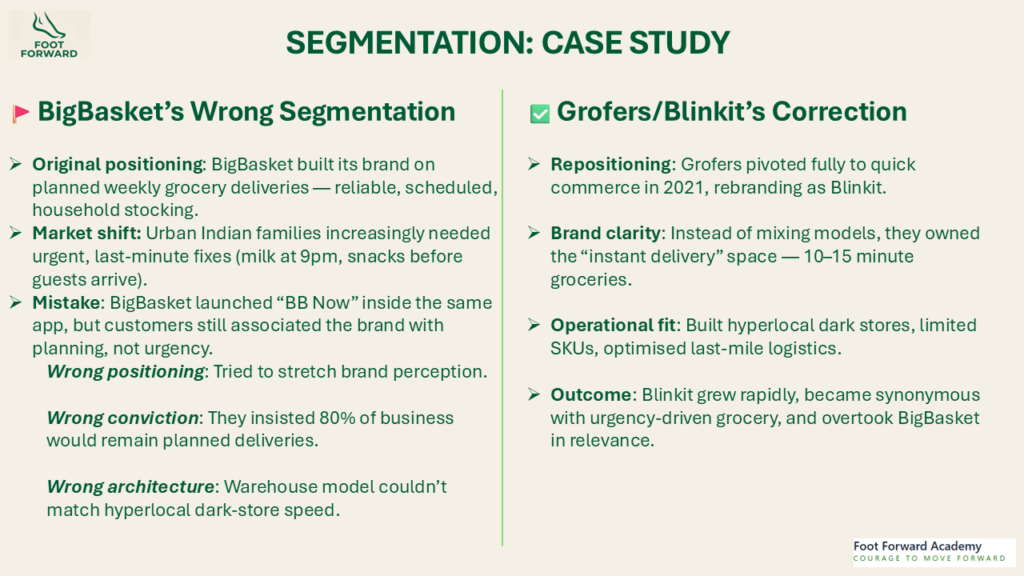
The AHLAD Segmentation Discussion Begins
Mr Singh: Which of these will be AHLAD’s primary segment?
Som hesitated.
Som: Earlier I would have said all. Now I realise each segment needs a different business model.
Example
Students
- Budget pricing
- Group seating
- Snacks
- Evening traffic
- Social media engagement
IT Professionals
- Wi-Fi
- Charging points
- Quiet environment
- Premium beverages
- Longer dwell time
Highway Travelers
- Fast service
- Clean washrooms
- Parking
- Family seating
- 24×7 possibility
These are practically just three different business segmentations. There are several more depending on location, format, city, etc.
Mr Singh: Exactly. The number of segments isn’t fixed. What matters is that AHLAD picks a few and builds a model around them — instead of trying to serve all of them at once.
A Simple Segmentation Framework for AHLAD
Som: Help me figure out the correct segment.
Mr Singh wrote four questions.
Mr Singh: Any retail business can start with these four questions.
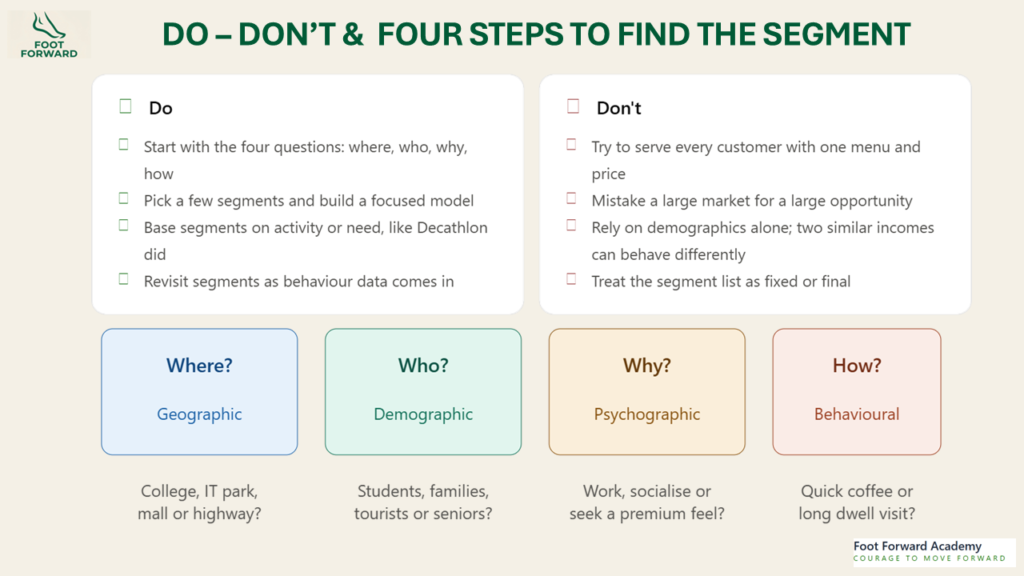
Where?
“This helps us decide the Geographic Segmentation. Should AHLAD open near a college, an IT park, a shopping mall, a hospital, or on a highway?”
He moved to the second box.
Who?
“This is Demographic Segmentation. Are we serving students, working professionals, families, senior citizens, or tourists?”
Then he wrote,
Why?
“This is Psychographic Segmentation. Some customers visit a café to work peacefully, some to spend time with friends, while others simply want a premium experience.”
Finally, he completed the last box.
How?
“This is Behavioural Segmentation. How frequently does the customer visit? What brings them here? A quick coffee before work, a family outing, a business meeting, or simply a place to relax?”
Mr Singh handed the tissue to Som.
“Remember these four questions. Whenever you study a successful retail brand, you’ll find that it has already answered them.”
Som looked at the paper and smiled.
“So before deciding the menu, pricing, interiors, or even the location, AHLAD must first answer these four questions.”
Mr Singh nodded.
“Exactly. Successful retailers don’t start with the product. They start with the customer.”
Som: This is much more practical than textbook definitions.
The Most Important Insight
As the mall began closing, Som asked one final question.
Som: If segmentation is so powerful, why do many entrepreneurs ignore it?
Mr Singh looked toward the food court.
Mr Singh: Because saying “I want every customer” feels ambitious. Saying “I want this specific customer” feels limiting.
But retail is not won by the biggest dream.
It is won by the clearest customer understanding.
He continued:
A brand becomes strong when a particular customer says, “This place is made for people like me.”
Som remained silent for a moment.
He looked at the AHLAD notebook again.
For the first time, he was not thinking about menu items or store count.
He was thinking about people.
Different people.
Different needs.
Different expectations.
And perhaps, the future of AHLAD depended not on how many customers existed in the market, but on which customer AHLAD truly wanted to serve.
As they stood up to leave, Som smiled.
Som: We have identified many customer groups. But we still have not decided which one AHLAD should choose.
Mr Singh: Exactly, Som. You take time to figure out segmentation; meanwhile, we will move ahead in our journey.
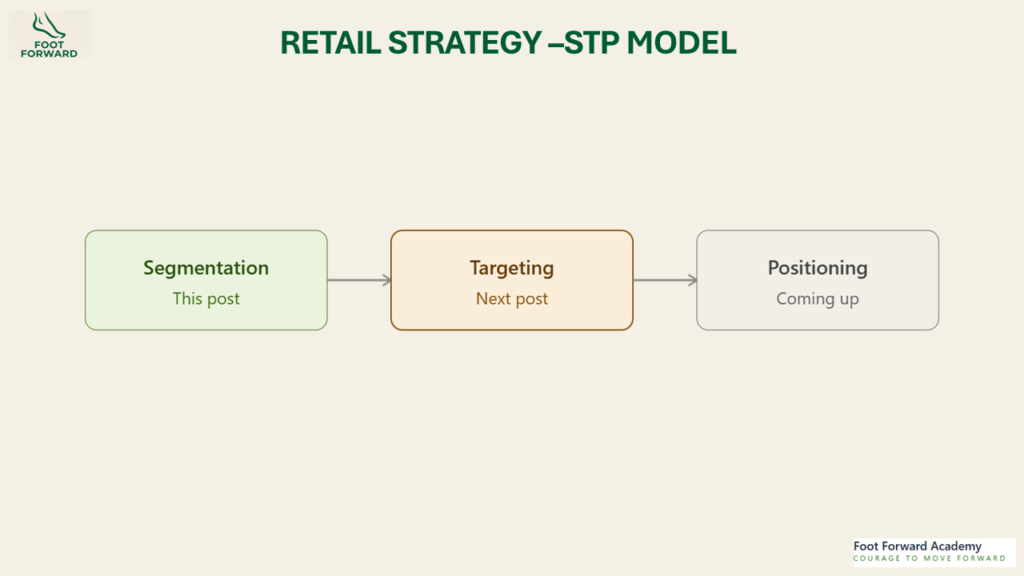
Next meeting, we will learn the hardest part of business—
Targeting.
Pingback: Strategic Targeting: Choosing the Right Customer