Som’s Retail Journey | Part 10
SEGMENTATION IDENTIFICATION
Aug 08, 2026 | 8–9 min read
Retail Strategy Segmentation: Field Research Across Café Chains
The discussion on Retail Strategy segmentation with Mr. Singh kept replaying in Som’s mind. Sitting in his room, surrounded by menu cards, promotional flyers, and pages of handwritten notes, he suddenly realised something.
No amount of reading can replace what customers do in the real market.”
If Café AHLAD had to solve a genuine customer problem, the answers wouldn’t be found on Google or in business books. They would be found where people actually spent their time, spent their money, and more importantly, why they chose one café over another.
Over the next seven days, Som turned himself into a silent observer. He visited Starbucks, Costa Coffee, Third Wave Coffee, Tim Hortons, Pret A Manger, Chaayos, Chai Point, Tea Post, and even a few neighbourhood tea stalls. At every outlet, he ordered a beverage, picked a quiet corner, and simply watched. He noted menu prices, observed customer behaviour, estimated dwell time, listened to conversations, and carefully studied the experience each brand was trying to create.
Very soon, a pattern began to emerge.
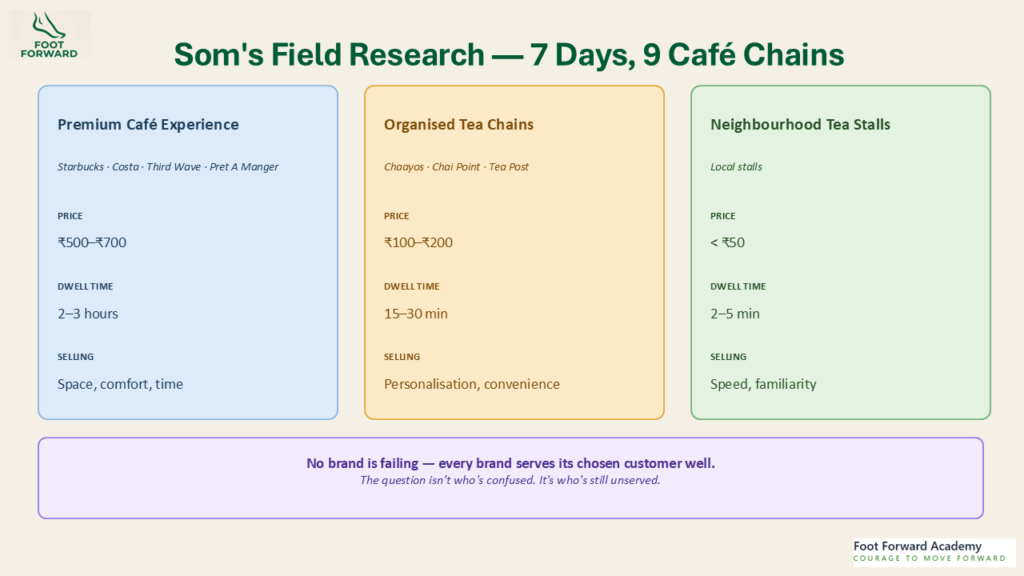
At Starbucks, many customers settled in with laptops, comfortably occupying a table for two to three hours. It was more than just a café—it was a Third Place, a comfortable bridge between home and office. A coffee and a light snack could easily cost between ₹500 and ₹700, yet customers willingly paid because they were buying much more than a beverage. They were buying comfort, space, and uninterrupted time.
Costa Coffee, Tim Hortons, and Third Wave Coffee followed a similar philosophy. Although each brand had its own personality, they catered largely to customers looking for premium ambience, conversations, informal meetings, or a comfortable place to work and spend time.
Pret A Manger offered a different proposition with its fresh food and grab-and-go concept. Yet its premium locations and international operating standards still positioned it beyond the everyday spending capacity of many urban Indians.
When Som visited organised tea chains such as Chaayos, Chai Point, and Tea Post, he noticed another interesting trend. Each brand had carved out its own space in the market. Chaayos celebrated customised chai experiences. Chai Point focused on convenience for busy professionals. Tea Post blended affordable pricing with a neighbourhood café experience rooted in Indian flavours.
Even the local tea stalls had loyal customers. They weren’t competing on ambience or premium beverages. They were solving a different problem—speed, familiarity, and affordability.
As the week came to an end, Som realised something that surprised him.
No brand was actually failing.
Every one of them was serving its chosen customer exceptionally well.
Closing his notebook, he wrote quietly,
“Every successful café knows whom it serves.”
He paused for a few seconds before writing another sentence underneath.
“But they are all solving different customer needs.”
Som looked around the busy café one last time.
Some customers wanted a workplace.
Some wanted conversations.
Some wanted premium coffee.
Some simply wanted a quick cup of tea.
Then a new question crossed his mind.
“What about the person who doesn’t want to spend hours in a café… doesn’t want only a cup of tea… but simply wants to pause, refresh, eat something healthy, and leave feeling better than when they entered?”
He closed his notebook.
For the first time, he felt he wasn’t searching for another café concept.
He was searching for the moment when people needed AHLAD.
Retail Strategy Segmentation: Uncovering the Gap in the Indian Market
Armed with a week of observations, Som requested another meeting with Mr Singh along with Vishnu Priya. This time, they met at a bustling high-street food hub, where cafés, quick-service restaurants, and tea chains stood side by side, each attracting a different set of customers.
As soon as they settled down, Som spread several comparison sheets across the table.
“I’ve spent the last seven days studying the organised café market,” he began. “What surprised me wasn’t the difference between the brands. It was how clearly each one understood its customer.”
Mr. Singh smiled.
“That’s an interesting observation. Tell us more.”
Som pointed towards the first comparison sheet.
“Starbucks, Costa Coffee, Third Wave Coffee, Tim Hortons, and Pret A Manger all compete differently, but they have one thing in common. They create an experience where customers willingly spend time. Some work on laptops, some conduct meetings, while others simply enjoy the ambience. They’re not just selling coffee—they’re selling an experience.”
He moved to the next sheet.
“Then I visited Chaayos, Chai Point, Tea Post, and even several neighbourhood tea stalls.”
“They are equally clear about their purpose. Chai Point focuses on convenience for busy professionals. Tea Post builds a neighbourhood tea café rooted in Indian flavours. Chaayos celebrates personalised tea experiences, while local tea stalls continue to win customers through affordability, familiarity, and speed.”
Vishnu Priya looked at him thoughtfully.
“So every brand already has a clear purpose in the market?”
“Exactly,” Som replied.
“I didn’t find confused brands.”
“I found focused brands.”
Mr. Singh nodded with satisfaction.
“So where is AHLAD’s opportunity?”
Som remained silent for a few seconds before pointing towards the crowd moving through the food hub.
“That’s where my thinking changed.”
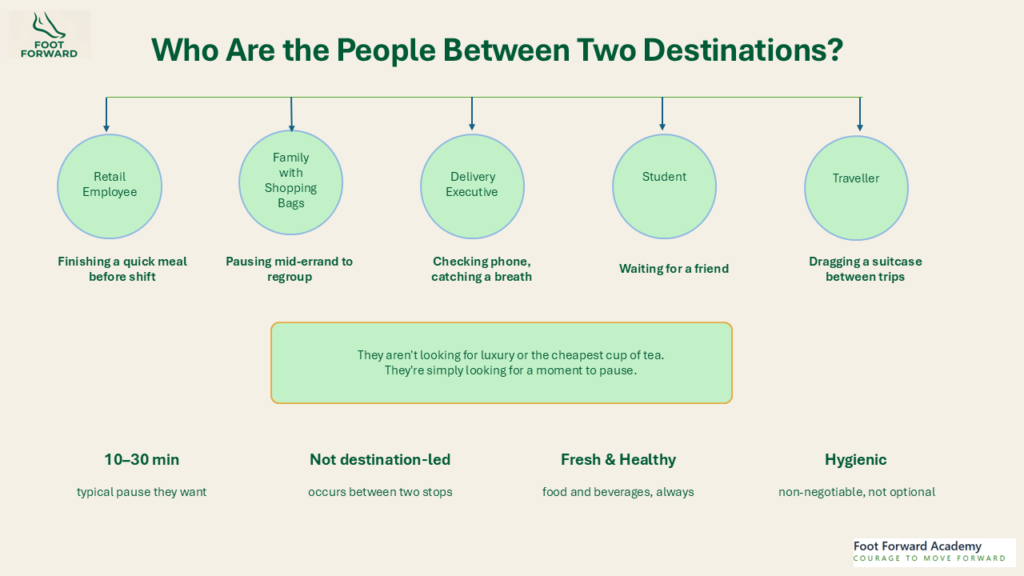
He pointed towards a retail employee finishing a quick meal before returning to work.
Then towards a family carrying shopping bags.
A delivery executive checking his phone.
A student waiting for a friend.
A traveller dragging a suitcase.
“They all look different,” Som said, “but I noticed something common.”
“They’re all between two destinations.”
“They aren’t looking for luxury.”
“They aren’t looking for the cheapest cup of tea.”
“They’re simply looking for a moment to pause.”
Mr. Singh leaned forward.
“What kind of pause?”
“A place where they can sit for ten or fifteen minutes, enjoy fresh food, recharge themselves, gather their thoughts, and continue with the rest of their day.”
For a moment, nobody spoke.
Then Som quietly added,
“I wasn’t looking for an unserved customer segment.”
“I was looking for that unmet need—a place where people could pause, nourish themselves, refresh their mind, and continue with their day.
Mr. Singh smiled.
“And what need is that?”
Som looked at the word written on the cover of his notebook.
“AHLAD.”
“A moment of refreshing bliss in the middle of a busy day.”
Mr. Singh closed the notebook.
“Excellent, Som.”
“You’ve stopped analysing cafés.”
“You’ve started understanding human behaviour.”
Identifying AHLAD Segment
Som turned to a fresh page in his notebook.
In the centre, he had written one word in bold letters.
AHLAD
“I’ve realised something,” he began.
“We shouldn’t build AHLAD around tea.”
“Or coffee.”
“Or even healthy food.”
Mr. Singh smiled.
“Then what are we building?”
Som looked at both of them before answering.
“We’re building a feeling.”
“The name AHLAD itself means joy, delight, and refreshing bliss.”
“Every successful brand owns a feeling in the customer’s mind.”
“Starbucks owns the idea of a premium café experience.”
“Chaayos owns personalised chai.”
“Chai Point owns convenience.”
“So what should AHLAD own?” Vishnu Priya asked.
Som answered without hesitation.
“AHLAD should own that brief moment when a busy person feels refreshed before stepping back into life.”
He continued,
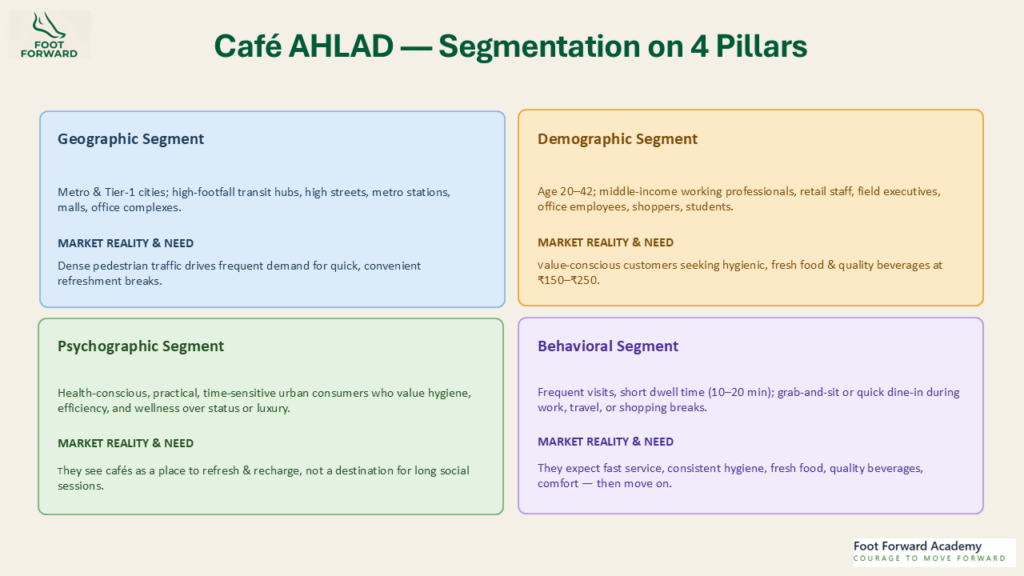
“Our customers may be office executives, retail associates, field sales professionals, students, shoppers, travellers, or hospital visitors.”
“They belong to different age groups.”
“They earn different incomes.”
“They live different lifestyles.”
“But at some point during the day, they all experience the same need.”
“They need to pause.”
“They need to refresh.”
“They need to feel better before continuing.”
Mr. Singh nodded.
“So your segmentation isn’t based on age or income.”
“It’s based on a shared human moment.”
“Exactly,” Som replied.
“Demographics help us understand who visits.”
“But emotions explain why they visit.”
He turned the page and summarised the concept.
Café AHLAD at a Glance
Purpose
To create a moment of refreshing bliss where busy urban Indians can pause, refresh, rejuvenate, and continue their day with renewed energy.
Food & Beverage
Fresh, hygienic, wholesome food complemented by quality tea and coffee, served at an accessible mid-price point.
Environment
A clean, comfortable, air-conditioned café designed for short but meaningful breaks, combining speed, hygiene, convenience, and warmth.
The Brand Promise
Customers may enter for tea or coffee.
They should leave with AHLAD.
For a few seconds, the three of them sat quietly.
Mr. Singh finally broke the silence.
“Today, you didn’t define a café.”
“You defined what the customer should feel after leaving it.”
Som closed his notebook; the market no longer looked like an invisible crowd. It had transformed into a map of different customer needs, behaviours, and opportunities.
As Mr. Singh stood up to leave, he turned back with one final thought.
“Understanding the market is only the beginning, Som. Every retailer can identify opportunities. The real challenge is deciding which opportunity is worth building your future on.”
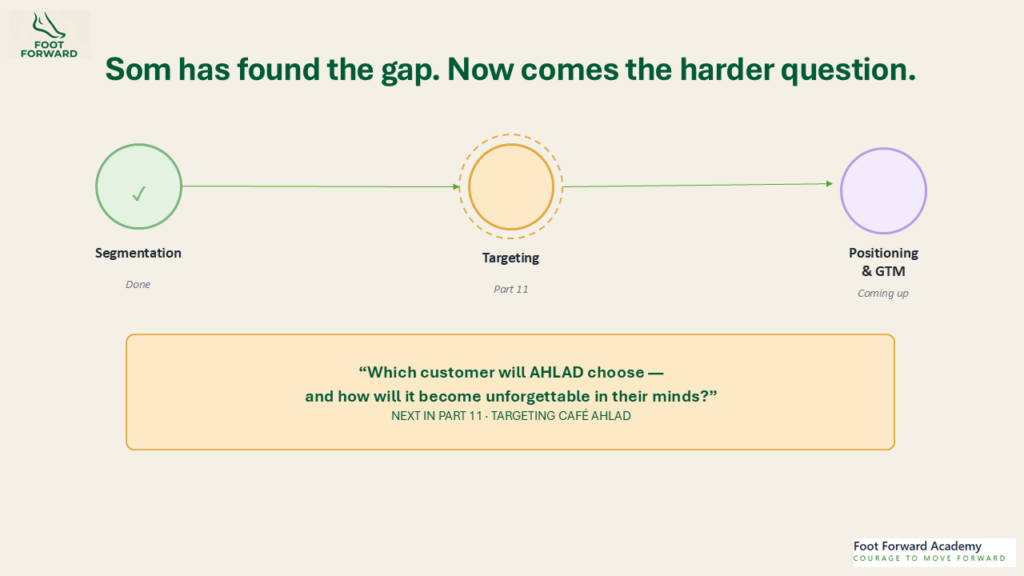
“Now comes the hardest part—which customer will AHLAD choose, and how will it become unforgettable in their minds?”
Next in Part 11: Targeting Café AHLAD – Choosing the Customer Who Will Choose You.