
Som’s Retail Journey | Part 11
Deciding Who You Will Serve — And Who You Will Let Go
Sep 06, 2026 | 10–11 min read
“What Is Strategic Targeting? Som’s First Question”
Som’s thoughts hovered around the question, “Which customer will AHLAD choose, and how will it become unforgettable in their minds?” How to choose a customer? Which type of customer should be selected? Is it Strategic targeting?
Mr. Singh is abroad on a project; Vishnu Priya is unavailable for an immediate meeting. Som’s curiosity forced him to start reading books, browsing the internet, and studying case studies to understand the concept of Strategic targeting.
This is the first time books pulled him in. He summarised targeting as the process of evaluating segments and deciding which one(s) to pursue with your product or marketing efforts.
“Too Many Targeting Options, No Clear Choice”
Som had already identified multiple customer segments for AHLAD, but now came the difficult part — deciding which one should actually be targeted.
He looked at his notes again.
There were too many possibilities.
Occasion/Situational Segment:
People commuting, waiting for transport, between meetings, in the middle of shopping, taking a break during a delivery run, or simply waiting for a friend.
Benefit-Sought Segment:
Customers looking for a quick physical or mental reset from fatigue, heat, or hunger.
Those who wanted guaranteed hygiene and freshness rather than adventure or variety.
Efficiency-seekers who valued speed and zero friction over experience or ambience.
Occupation/Role-Based Segment:
Gig and delivery workers, retail and mall staff on shift breaks, students between classes or coaching, business travellers in transit, and shoppers moving through the mall with bags.
Usage-Rate / Loyalty Segment:
People following the same commute route, travelling at the same time, or repeatedly passing through the same location.
Price sensitivity Segment:
Value-conscious professionals. Trade-up seekers from unorganized/street vendors wanting hygiene upgrade, Trade-down avoiders from premium cafés wanting to save time/money without losing quality
Som leaned back.
Every segment seemed to have a reason to choose AHLAD.
But that was exactly the problem.
Which one should AHLAD choose?
The research paper says that to evaluate your segments effectively, you should apply structured criteria such as measurability, accessibility, substantiality, actionability, durability, and alignment with company resources.
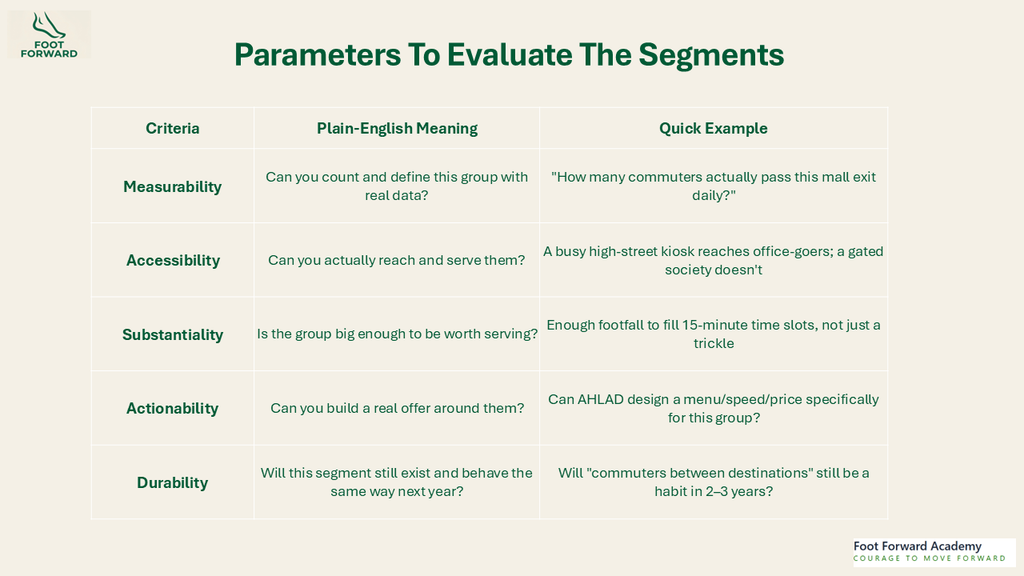
Som got stuck in the technical jargon. It looked very difficult to him. His idea of launching AHLAD looked feeble. He got panicked and perplexed. All of a sudden, his phone rang. Vishnu Priya was at the other end.
“A Strategic Targeting Lesson From the Mall — Or So Som Thinks”
She understood Som’s situation. Since an immediate meeting was not possible, she asked Som to visit the nearest mall. Check the denim brand stores and spend some time in-store, watching customers visiting the brands.
Som reached the mall. It was already 5 PM in the evening. The mall had good walk-ins. He visited Levi’s, Jack & Jones, Spykar, and a couple more denim brands.
He noted down the learnings:
| Feature | Levi’s | Spykar | Jack & Jones |
| Core Identity | Timeless Heritage & Authenticity | Edgy, Youth-Centric Homegrown Streetwear | Fast-Fashion & European Modern Style |
| Primary Target | 18–40+ (Mass Appeal, Urban Professionals) | 16–25 (College Students, Gen-Z) | 20–35 (Urban Millennial Men) |
| Design Aesthetic | Classic cuts, minimalist washes, clean fits (501, 511, 512) | Distressed, heavily washed, ripped, bold details | Trendy, experimental, European streetwear & tailored denims |
| Price Point | Mid-to-Premium (₹2,200 – ₹8,000+) | Value-to-Mid (₹1,500 – ₹4,500) | Mid-to-Premium (₹2,500 – ₹7,000+) |
| Key Message | “Quality, durability, and classic American culture” | “Rebellious spirit & youthful expression” | “Contemporary fashion and lifestyle for men” |
If three brands selling the same product — denim — can all succeed with completely different customers, he thought, then targeting isn’t really about choosing. It’s about finding the right message for whoever walks in. Every segment has potential, if you speak to it right
He closed the notebook, more relaxed and confident, and eagerly waited for the meeting, which would be after a week.
“You Haven’t Heard the Name”
Som and Mr. Singh were sitting in Starbucks. Som was eager to share his learning on Strategic targeting. He slid the notebook open to Denim comparison page .

“Look,” Som said. “Levi’s, Spykar, Jack & Jones — completely different customers, completely different price points, completely different messages. So every segment has potential and equal opportunity to grow and deliver the business.
Mr. Singh glanced at the table, then back at Som — the look of someone about to gently correct a half-right answer.
“You’ve proven three brands can each win one customer,” he said. “You haven’t yet seen what happens when a brand tries to win the wrong one.” He paused. “Tell me about Bisleri Pop and Spoon Joy.”
Som was shocked! From where did these terms pop up?
Mr. Singh, “Do you agree the soft drink market is big in India? Bisleri is a well-known brand. So, they would have launched the product and should have captured a large share of the market.”
Som, “Yes, surely.”
Mr Singh, “Still, you have not heard the name. Is it not surprising?”
Bisleri Pop – A strategic Targeting Struggle
Mr. Singh continued, Bisleri introduced a line of brightly coloured, fruit-flavoured carbonated drinks (Fonzo, Spyci, Limonata, Pina Colada) in flashy cans with quirky, youth-centric advertising to compete directly with Coke, Pepsi, and Fanta.
They targeted: Gen-Z teens, college students, and young adults (18–25) looking for edgy, alternative party beverages.
Bisleri built its identity around purity, hydration, safety, and health. Its identity did not match the product. It failed to create the excitement of carbonated buzz; it did not match social badges, mixer, or indulgence options.
Despite massive capital backing, nationwide retail placement, and high-profile youth marketing, the product failed to gain traction. Consumers refused to accept Bisleri as a soft drink brand. The company pulled the line from shelves, later attempting minor individual relaunches (like Fonzo or Limonata) while scrubbing the primary Bisleri umbrella branding from the front of the cans to fix the audience disconnect.
Spoon Joy – A Strategic Targeting Struggle
Som, in curiosity, “What about Spoon Joy?”
Mr. Singh, “An authentic, standalone Indian food and beverage startup (not a brand extension or subsidiary) that failed in its initial stage due to a pure demographic mismatch and wrong strategic targeting is SpoonJoy (2014–2015).”
They targeted: Spoon Joy targeted tech-savvy corporate employees and office workers in urban hubs like Bengaluru and Delhi NCR.
The Core Pitch: A subscription-based food-tech platform offering healthy, curated, portion-controlled gourmet meals for daily lunch office deliveries.
Som, “This is a great concept. Somewhat AHLAD also has the same soul—to provide healthy, hygienic food with mental peace. No competition in this case. I should have rocked.”
Mr. Singh, “But the model collapsed in a year.”
Som found himself in an awkward situation. He spoke, “Maybe some operational issues.”
Mr, Singh spoke,” It is more likely due to incorrect targeting. The vast majority of the target demographic had strict spending caps for daily meals and was highly price-sensitive. The segment was small, and frequency was also low. It also did not match the behaviour and culture. Employees rely on subsidised company cafeterias, home-packed dabbas, or local affordable eateries. They do not want to lock in their lunch choices in advance and prefer flexibility and cheaper daily variety.”
Within roughly a year of launching, SpoonJoy ran out of capital, shut down operations in Delhi and Bengaluru, and was acquired in a distress sale by Grofers (now Blinkit) in late 2015.
Som, “I need more clarity. The above examples put me on the back seat to launch AHLAD.”
Mr. Singh, “Your Levi’s, Spykar, and Jack & Jones reading is correct. Let’s build on the same with one more live case.”
Twenty Minutes on the Mall Floor
“Watch three stores,” Mr. Singh said. “H&M, Zara, and Louis Vuitton. Don’t buy anything. Just watch who walks in, how they’re treated, and what they leave with. Twenty minutes.”
Som left his coffee half-finished and walked down.
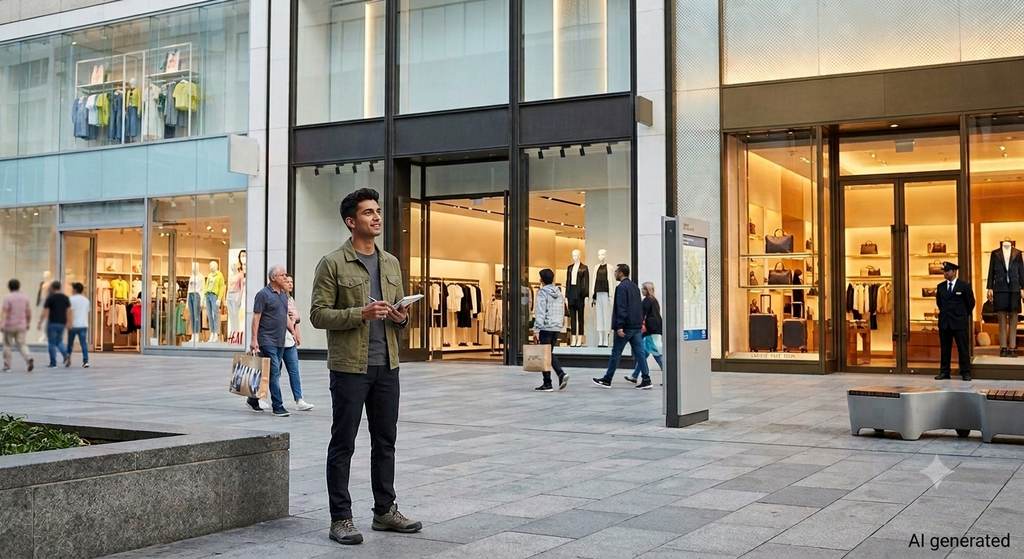
At H&M, the entrance was wide open — no doors, just a threshold people crossed without slowing down. Racks stood dense, prices printed in bold, and all three checkout counters had queues. A mother pulled two kids toward the sale section. A student compared two T-shirts by price before either had a chance to be about fit.
At Zara, next door, there was no signage promising a discount. The store was just as busy, but quieter. Customers walked slower, checking the fabric, holding pieces against themselves at mirrors placed every few metres. Nobody seemed to be looking for the cheapest thing on the rack.
Louis Vuitton was different before he’d even reached the entrance. A single security guard stood at the door. Inside, there wasn’t a rack in sight — one customer stood at a glass counter while a single associate opened a drawer and placed one bag in front of her, and only her. Nobody checked a price tag.
Som stood outside for a moment, watching a woman leave the boutique holding one small paper bag with a rope handle — the only thing she’d carry out of that visit.
He went back upstairs.
“Well?” Mr. Singh asked, not looking up from his coffee.
“They’re not selling the same thing,” Som said, sitting down. “H&M is selling speed and price. Zara is selling the newest look, right now, before it’s gone. And Louis Vuitton isn’t really selling a bag at all.”
“What is it selling?”
Som thought for a second. “The feeling of being the only person in the room.”
Mr. Singh smiled and set down his cup.
“That’s strategic targeting.”
The Three Things You Just Found
“Write down what you noticed,” Mr. Singh said. “Not what I tell you — what you saw.”
Som opened his notebook and began listing.
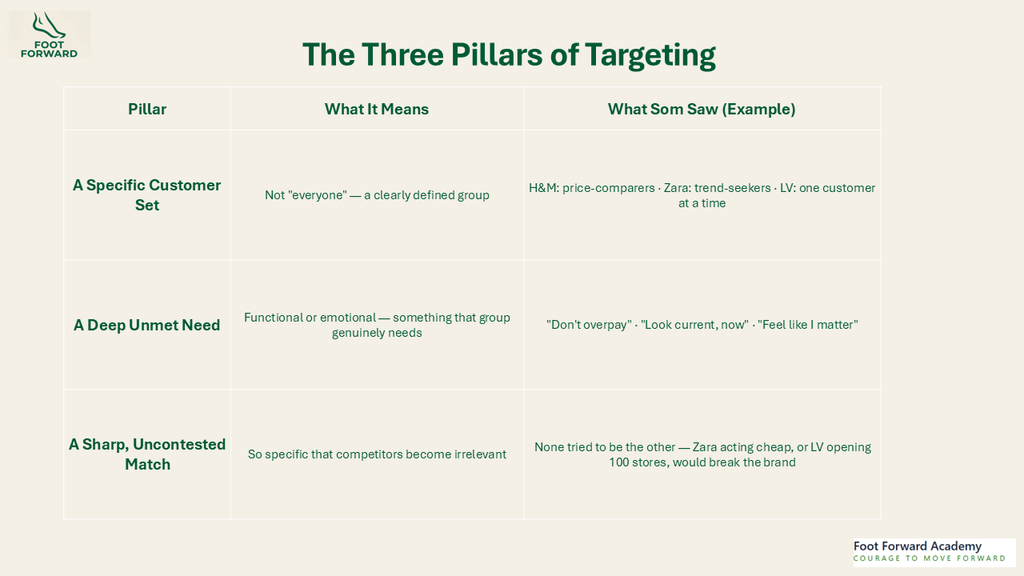
“One. Each store had a very specific kind of person walking in. H&M — families, students, anyone comparing prices. Zara — people who wanted to look current without paying luxury prices. Louis Vuitton — people who didn’t check a single price tag.”
“Two. Each one was solving something different. H&M is solving ‘I need clothes and don’t want to overpay.’ Zara is solving ‘I want to look like the runway, today.’ Louis Vuitton is solving something that isn’t functional at all — it’s solving ‘I want to feel like I matter.’”
“Three.” Som paused. “None of them tried to be the other. If Zara tried to be as cheap as H&M, nobody would trust the fashion. If Louis Vuitton opened a hundred stores like H&M, nobody would want to be seen carrying the bag anymore.”
Mr. Singh nodded slowly.
“You just defined the three pillars of startegic targeting yourself, Som. The specific customer set. The deep unmet need — functional or emotional. And a clear match, communicated so sharply that competitors become irrelevant to that customer.”
He tapped the table. “Write it properly. You’ll want this later.”
| Store | Who Walked In | What They Were Solving | What Som Noticed |
| H&M | Families, students, price-comparers | “I need clothes and don’t want to overpay” | Wide-open entrance, dense racks, three busy checkout counters |
| Zara | Trend-conscious shoppers, no bargain hunting | “I want to look current, right now” | No discount signage, slower browsing, mirrors everywhere |
| Louis Vuitton | One customer at a time | “I want to feel like I’m the only one who matters” | Security at the door, single associate, one bag placed at a time |
Som closed his notebook. For the first time since he’d started reading that research paper, the words on the page had turned into something he could actually see — a customer walking through a door, a need he could name, a shelf full of choices that weren’t really competing with each other at all.
But watching three fashion brands do this well was one thing. Doing it himself, for a business that didn’t exist yet, was another.
“Alright,” Mr. Singh said, standing to leave. “You understand what targeting looks like when it’s done right. Next time, we do the harder thing — we find AHLAD’s version of it. Not by watching someone else’s customers walk in. By figuring out, segment by segment, which one is actually yours.”
Next in Part 12: Strategic Targeting for AHLAD — Segment by Segment, Choosing the One That Fits.