
Som’s Retail Journey | Part 2
Differentiation of Organised and Unorganised retail
May 30, 2026 | 4–5 min read
The Excitement of Session 02
It was a bright, sunny day, and the atmosphere was filled with vibrant energy — Som’s enthusiasm was no less than his surroundings. Excited for his next session, he drove passionately toward the venue.
His mind was completely engrossed in thoughts of retail. Looking around, he found himself analysing every store he passed — evaluating their size, product range, frontage, visibility, and whether they sold branded or unbranded goods. Every moment was an opportunity to learn through observation. With a flurry of evolving thoughts and queries in his mind, he decided to lay them all out before Vishnu Priya for a better understanding of retail formats.
Peace at the Venue
Today, they were meeting at a Barista Café located on one of the city’s most prestigious high streets. It was Som’s first time visiting this Barista. While he was familiar with the high street, he wasn’t very familiar with its exact layout and had been a little sceptical about the venue choice, worried that parking might be an issue.
However, as he reached the high street, his eyes quickly caught the prominent Barista signage and its decent facade. His anxiety settled completely the moment he spotted a parking board near the café.
Meeting & Greeting
Vishnu Priya (VP) was already inside, just wrapping up a meeting with another client. She waved at Som with a pleasant smile, signalling him to wait at another table.
Within a couple of minutes, their conversation began.
“Hello, Vishnu Priya,” Som started. “As discussed in our phone conversation, I have made a list of the articles and services I purchased from various types of retail stores over the last seven days.”
- Pan Masala: Rashtriya Pan Darbar (Pan Parlor)
- Buttermilk: Amul Parlour
- Vegetables: Dwarka Vegetable Market
- Almonds: Kishan Kirana
- Fruits: Reliance Fresh
- Laptop: Croma
- Apple Mobile Charger: Apple Store
- Screws: Om Hardware Shop
- Toys: Hamleys
- Medicine: Apollo Pharmacy
- Laundry: Munna Laundry
- Haircut: Truefitt & Hill
- Birthday Decoration: Vijay Decorators
- Private Taxi: Uber
- Tap Repair: Shyam Plumber
- Garments: Marks & Spencer
- Edible Oil: Reliance Smart Bazaar
- Sports Shoes: Adidas
- Smartwatch: Amazon
- Gold Earrings: Malabar Gold & Diamonds
- Blankets for Donation: DMart
- Fitness Equipment: Decathlon
- Sweets: Madan Lal Sweets
Vishnu Priya was delighted to see the extensive list, which beautifully spanned across various retail formats. “This is a great mix of organised and unorganised retail purchases,” she remarked.
Som looked at her with curiosity.
Vishnu Priya continued, “organised and unorganised retail are classified based on certain distinct parameters. “
- Business Registration & Legal Structure
- Structure, Ownership & Management
- Scale & Format
- Team Size & Employment
- Infrastructure & Technology
- Shopping Experience
- Geographical Reach
- Data Reporting
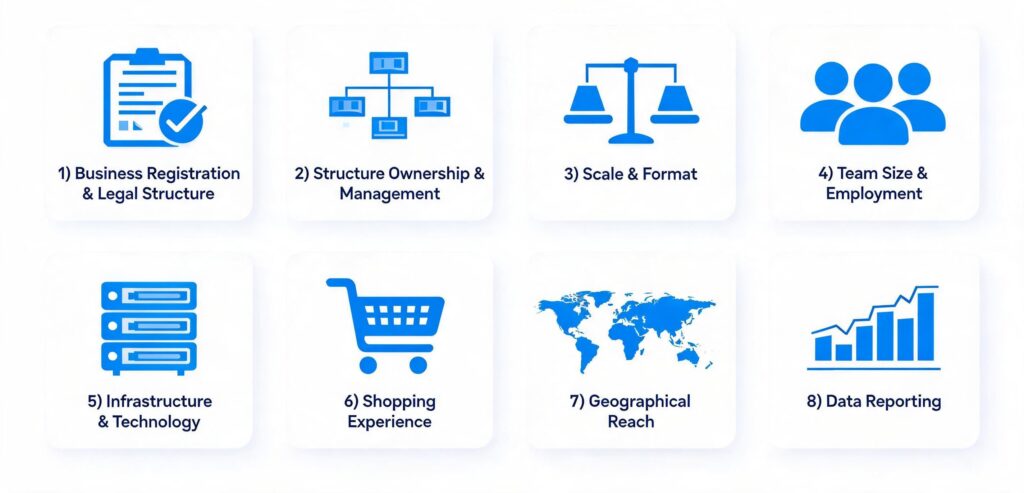
Key Differences Between Organised & Unorganised Retail
1. Business Registration & Legal Structure
Unorganised retail is largely unregistered, tax compliance is only partial, and business owners operate with minimal licensing, such as a basic Shop & Establishment license. In contrast, compliance across all three of these parameters is strictly mandatory for organised retail.
Som, You Buy laptop from Croma for your company. You will get GST bill. You can claim from government. On purchase of office furniture from Om Hardware shop will give manual bill. GST cannot be claimed.
2. Structure & Management
Vishnu Priya Continues, Unorganised retail typically consists of self-owned or family-run businesses. They lack Standard Operating Procedures (SOPs), defined hierarchies, and clear job roles. Organised retail, on the other hand, is entirely process-driven and managed by corporates or professionals with well-defined roles for everyone.
3. Scale & Format
Som, unorganised retail lacks structure, it cannot easily scale across multiple locations, cities, or countries. It usually operates out of one or a few stores, entirely dependent on an individual’s working style. Organised retail is highly structured; its formats can be easily replicated across multiple stores while maintaining identical processes at every location.
Hey Som, Suppose you can buy Shoes from Adidas store in Mumbai and gift it to your brother in Rohtak. If he needs a size change, it can be done at any Adidas store in Rohtak.” This is impossible with local retailer.
4. Team Size & Employment
Vishnu Priya Leans forward, speaks, Unorganised retail is operated by individuals, family members, or informal labourers. The team size remains small, and employees do not receive social security or formal benefits.
Organised retail hires skilled manpower, often on a contractual basis, with defined roles. Employees enjoy benefits like ESI/PF and medical insurance. The team size is large, and as the business scales to multiple locations, the operations and backend teams expand rapidly.
5. Technology & Infrastructure
Unorganised retail relies on manual billing and lacks CRM or customer loyalty programs, relying instead on personal relationships. Organised retail utilizes robust POS (Point of Sale) systems, automated inventory management, data-driven loyalty programs, and well-defined supply chains.
These operations require precise deliverables, multiple warehouses, and strong IT systems for analysis, control, budgeting, and forecasting. Separate verticals—such as business development teams and store layout architects—are created for smooth execution.
Let’s understand it better way from DMART operational efficiency. The moment product is billed Central system triggers the replenishment. and feeds the data into the demand forecasting engine. DMART shelves are almost never empty with lowest inventory carrying cost.
In Kishan Kirana neighbourhood store operates manually. Kishan keeps record of items needed. He calls wholesaler once in 2-3 days. The day he is ill store gets in chaotic condition or gets closed. There is no system on Kishan.
6. Shopping Experience
Unorganised retail operates without SOPs, meaning pricing, returns, and exchange policies are fluid or undefined. Store ambience standards do not exist, so the environment can vary with every visit. The experience is largely driven by the shopkeeper’s mood.
Conversely, Organised retail is strictly process driven. Ambience standards, pricing, return policies, and delivery dates are set in stone. You will never encounter the unexpected, ensuring a consistent comfort level that builds long-term brand loyalty.
7. Geographical Reach
Driven by individuals with no standardized processes or division of labor, unorganised retail struggles with expansion, limiting owners to a single shop or a tiny handful of outlets. Organised retail features structures, roles, and tasks that are clearly defined. The success blueprint of one store can be effortlessly replicated across any part of the country or the world.
You know Som, Apollo Pharmacy has more than 5,000 stores in year 2025 & expanding but Vijay Decorates cannot scale beyond 2-3 outlets with their current structure.
8. Data Reporting
Unorganised retailers rarely disclose their sales, profits, or expenses, and many transactions remain undocumented. Organised retail maintains strictly audited financial data and rigorous compliance reports.
Vishnu Priya, “Oh, it’s my mother’s call. Hey Som, I may take some time to get back. After that, we will continue our conversation on organised and unorganised retail.”
Som, “No worries, I’ll be waiting.”
Som knew he had a long list of queries that would require time and multiple rounds of conversation to unpack.
Have you ever noticed the distinct benefits of one type of retail over the other in your daily life?
Do you prefer organized vs unorganized retail setups?
To be continued….