
Som’s Retail Journey | Part 1
Exploring the evolution of retail from Haat Bazaars to Modern Malls
May 24, 2026 | 4–5 min read
A Young Investor Searching for Business Opportunities
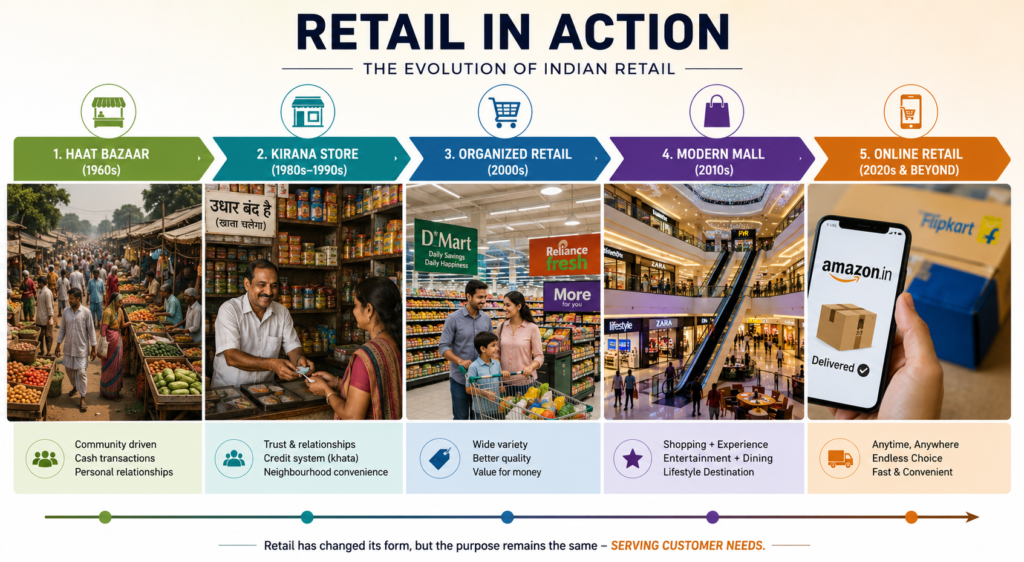
Som was a young man who had recently received funds after selling agricultural land. He had no prior experience in organized business but was eager to invest ₹100 million in a new venture. While exploring different business opportunities, he witnessed Retail In action and he became curious about the retail industry — a business he could see everywhere around him.
To understand retail better, Som met Vishnu Priya, a retail consultant. They decided to have their first meeting at Starbucks inside one of the city’s well-known malls.
Som was excited to learn about the business and reached almost 10 minutes early.
“For him, Starbucks felt like a completely new world” .He stood near the entrance, waiting for Vishnu Priya. A few minutes later, both settled into a quiet corner of the café.
What Exactly Is Retail?
Vishnu Priya noticed the curiosity in Som’s eyes. After taking a deep breath, she began:
“Som, retail is the simple process of selling goods or services to end consumers for personal or non-business use.”
It is one of the oldest forms of business in society. Look around your neighbourhood — grocery stores, Kirana shops, milk dairies, salons — all of these are examples of retail businesses.
Over time, retail has evolved from nearby local stores to malls and now even online platforms like Amazon.
Retail in the Early Days
Vishnu Priya continued, “retail was mainly focused on selling products. Simply making products available to customers was enough to run a business.
Manufacturers and producers such as farmers, weavers, cobblers, and potters started selling directly from their workplaces or homes. In a way, they became part-time retailers.”
She paused for a moment before continuing.
“However, this model had limitations. Their customer reach was low, their attention got divided from their primary work, and selling products became an additional burden. Many producers were also not comfortable interacting with customers regularly.
Customers faced challenges too. Product variety was limited, innovation was slow, and often they could not find exactly what they wanted.”
The Birth of HAAT BAZAR
Som nodded as the explanation slowly connected with what he had seen in villages and local markets.
“That’s when people realized something important,” Vishnu Priya explained. “Instead of everyone selling separately, why not create a dedicated marketplace where all producers and service providers could gather together to sell their products?”
“This idea led to the creation of ‘HAAT BAZAR’ — local marketplaces where people from nearby villages came together to buy and sell goods.”
She smiled and pointed around the mall.
“These markets were not just about shopping. They also had entertainment shows, dramas, magic performances, and food stalls to keep visitors engaged. Over time, retail evolved from HAT BAZAR culture to the modern mall culture where we are sitting today.”
Som’s eyes lit up. The comparison opened his imagination and helped him visualize how retail had evolved over time.
Vishnu Priya then offered coffee to Som. Both walked to the cash counter and placed their orders. The attendant wrote their names on the cups and requested them to wait for a few minutes.
Homogenous Market
As they waited, the conversation continued.
“Som, are you aware of the weaver community near your village?” asked Vishnu Priya.
“Yes,” Som replied. “They are experts in making fabrics, garments, textiles, and home décor products.”
“Exactly,” Vishnu Priya said. “Almost every household there is involved in weaving. Even though their profession is similar, their products differ greatly in design, quality, and specialization.”
“That type of setup is called a homogeneous market,” she explained.
“In such markets, similar types of products or services are available throughout the area. Examples include cloth markets, jewellery markets, utensil markets, and electronic markets.
These specialized markets attract customers who are looking for a particular category of product. They offer better variety, save customers’ time, and even attract buyers from distant places. It becomes a win-win situation for both sellers and customers.”
She added, “High streets in many cities are built around such specialized markets. Since customers visit these areas with a clear purchase intention, the sales potential becomes very high.”
Meanwhile, their coffee orders were ready.
Both collected their drinks and started walking through the mall atrium.
Visualising the Discussion
Som noticed that the entire ground floor was filled mainly with women’s fashion stores. He immediately connected it with their earlier discussion.
“This floor seems dedicated to women’s products,” Som observed. “Most stores here are related to garments, beauty, footwear, and accessories.
Vishnu Priya smiled. Som was beginning to observe retail like a retailer.
They took the escalator to the first and second floors, which were mainly focused on men’s and kids’ categories respectively. Even the floors were divided into zones based on customer segments.
Heterogenous Market
When they reached the top floor, Som noticed something completely different.
There were local stores mixed with a few branded outlets. Apparel stores stood beside eyewear shops, salons, swimwear outlets, and utensil stores. The arrangement looked less structured compared to the lower floors.
Vishnu Priya explained:
“Som, this is a perfect example of a heterogeneous market. Unlike specialized markets, these markets are not restricted to a particular gender, category, or occasion.
Their biggest strength is affordability and product availability for every member of the family.”
She paused and added, “In fact, the lanes of your village are also examples of heterogeneous markets.”
Both eventually returned to Starbucks. The same attendant welcomed them warmly and asked how they liked the coffee.
Recapping the Observations
After settling down again, Vishnu Priya asked:
“Well Som, can you recall some of the brands and stores you observed today?”
Som quickly replied,
“Lifestyle, Marks & Spencer, Time zone, Uniqlo, Tommy Hilfiger, Levi’s, H&M, Zara, Croma, PVR, Barista, Starbucks… and many more.”
“Excellent,” Vishnu Priya said. “Now tell me — how are these brands different from each other?”
Som thought for a moment and answered:
- Product
- Merchandise
- Categories
- Store Size
- Pricing
- Services
- Specialty
Vishnu Priya smiled proudly.
Very good, Som. In our next meeting, we will understand more concept of retail, its structure and challenges with brand examples.”