
Som’s Retail Journey | Part 12
Finding the Right Customer — And the Right Catchment
Sep 19, 2026 | 10–11 min read
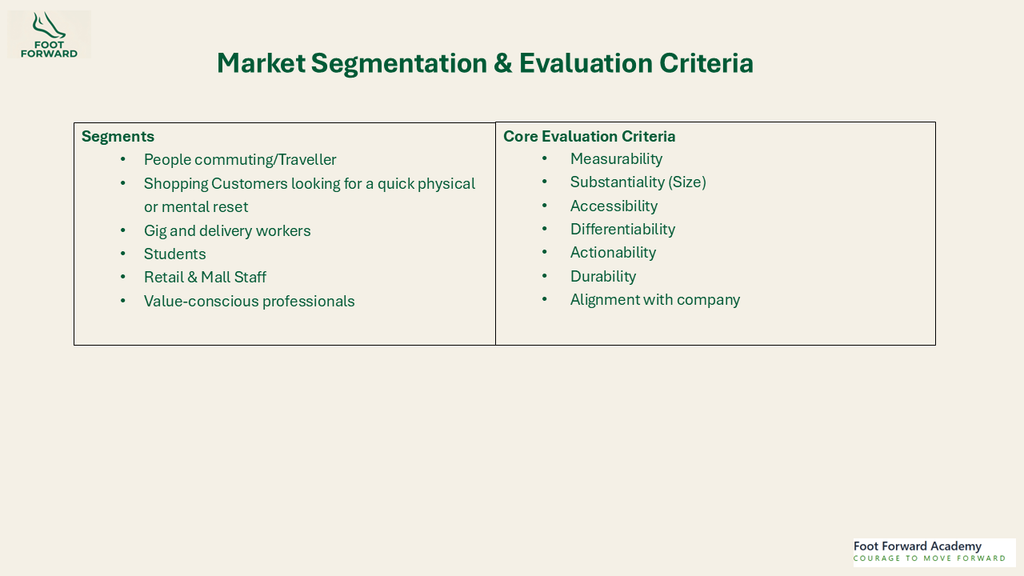
Som was contemplating how to select Strategic Targeting for AHLAD. He had segments and a methodology to evaluate them. He picked up a notebook and divided a page into two halves. One had the segments, and the other had the evaluation parameters.
The Most Attractive Segment
He decided to map every segment to the core evaluation criteria for deciding Strategic Targeting for AHLAD.
He started recalling the criteria description.
“Measurability.”
“Can I define and size the segment using real data?”
“Substantiality.”
“Is it large enough and profitable enough to justify targeting?”
“Accessibility.”
“Can AHLAD actually reach and serve them?”
“Differentiability.”
“Will this segment respond differently to AHLAD’s offer?”
“Actionability.”
“Can we actually design the Product, Price, Place and Promotion around them?”
“Durability.”
“Stability of segment characteristics over time.”
“Alignment with company.”
“Does the segment fit AHLAD’s resources, objectives and philosophy?”
After comparing, he decided that Gig and Delivery Workers should be the strategic target for AHLAD for the following reasons: high accessibility, high growth, high frequency, low competitive intensity, and a strong fit with the quick-pause concept.
This was the most attractive segment—a strategic target for AHLAD.
Can the Customer Afford to Come Back?
Som, with excitement, scheduled a video call with Vishnu Priya and Mr. Singh. He shared his strategic target for AHLAD—Gig and Delivery Workers.
“They fit the behaviour perfectly,” he said. “They are always between destinations. They need something quick, fresh, and convenient.”
Vishnu Priya smiled.
“Good.”
She leaned forward.
“Now tell me why they should be rejected.”
Som stopped.
“Rejected?”
“Yes. You have told me why they are attractive. Now tell me why they may be wrong.”
Som looked at Mr. Singh.
Mr. Singh shared the screen, showcasing the “we work” on one slide
Som said, “The office-space company.”
It was built for freelancers and startups. And they loved it—no lease to sign, a space whenever they needed one, a community around them. The behavioural fit was perfect.
“The people who loved it the most couldn’t keep paying for it at the scale the business needed. A freelancer renting one desk isn’t the same as a company renting three floors. Within a few years, WeWork had quietly rebuilt its real revenue on enterprise clients — companies with five hundred employees or more became over half their business. The customer they started with wasn’t the customer that kept them alive.”
That silence was becoming familiar.
Som went back to the numbers.
He changed the lens.
A segment could be attractive for AHLAD.
But could the customer afford AHLAD repeatedly?
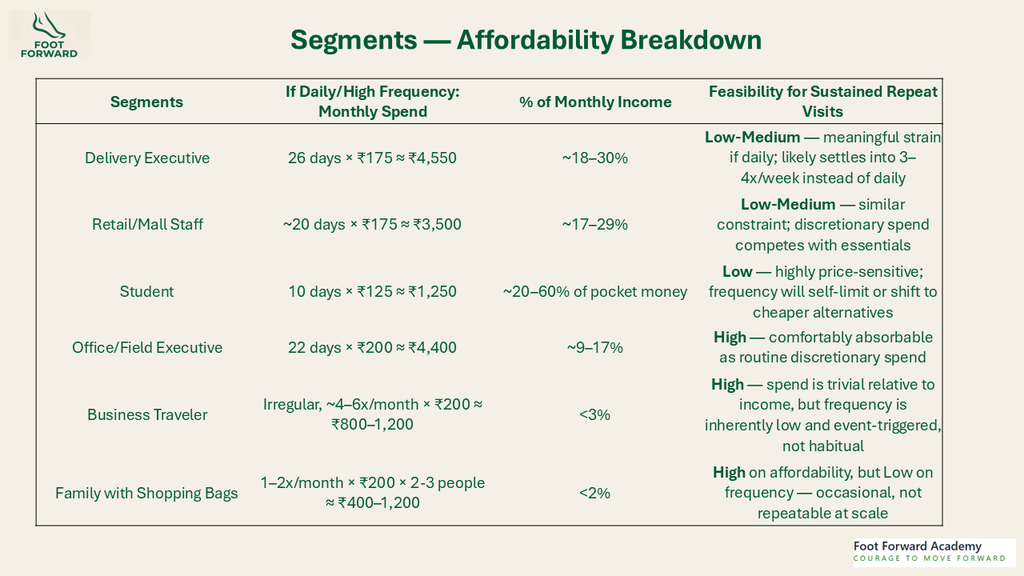
He looked at Delivery Executives.
Monthly income could be around ₹15,000–₹25,000.
Suppose the average spend was ₹175.
If a rider visited 26 days a month, the monthly spend would become approximately ₹4,550.
That could represent roughly 18%–30% of monthly income.
Som looked up.
“That is uncomfortable.”
Vishnu Priya nodded.
“Why?”
“Because the behaviour looks perfect for AHLAD. But the economics may not support the behaviour.”
“Exactly.”
Som continued.
Retail and Mall Staff had a similar problem.
Students were even more difficult.
A student spending ₹125 ten times a month could spend around ₹1,250.
But that could represent a significant portion of their pocket money.
Business Travellers had the opposite problem.
They could afford AHLAD easily.
But they would not visit regularly.
Families could afford a ₹400–₹1,200 basket.
But they might come only once or twice a month.
Then Som reached Commuters (Office and Field Executives).
Monthly income: ₹25,000–₹50,000.
Possible monthly AHLAD spend: Approximately ₹4,400.
Share of monthly income: Around 9%–17%.
Som looked at Vishnu Priya.
“This is different.”
“Say it.”
“Office and Field Executives can afford the habit.”
Vishnu Priya smiled.
“Now you’re thinking.”
Mr. Singh finally spoke.
“Remember something, Som. A customer who likes you but cannot afford to repeat is not necessarily your best target.”
Som nodded.
“Targeting is not about who can buy once.”
“Correct.”
“It is about who can keep buying.”
“Now you understand the difference.”
But Som realised that affordability alone was not enough. He needed a market where these customers were present frequently enough—and where AHLAD’s Quick-Pause concept could actually work.
Customer Feasibility Is Only Half the Equation
Som said, “The Office and Field Executive segment is a strategic target for AHLAD.”
Mr. Singh asked, “On what basis?”
“Their affordability means financial feasibility.”
Mr. Singh looked at him.
“What about AHLAD?”
Som replied, “Very simple. My cafés will be more economical. People will visit my café.”
Mr. Singh immediately shook his head.
“Why are the existing players not doing that?”
Som remained silent.
“Think about it,” Mr. Singh continued. “If reducing the price was the easiest way to win this customer, why haven’t the existing players already done it?”
Som had no answer.
He continued, “A café has rent. Salaries. Electricity. Equipment. Maintenance. Ingredients. Wastage. Technology. Delivery commissions. Interiors. Marketing.”
“You cannot simply reduce the price and assume the customer will come in large enough numbers to compensate for the lower margin.”
Som understood.
“So if I reduce the price too much, my economics fail.”
“Exactly.”
Som thought for a moment.
“But I have a plan for a Quick-Pause Café. The concept is different. So I can serve more customers.”
Mr. Singh nodded.
“Brilliant thought. But will it match the customer behaviour or the requirement?”
Som responded, “I will open the café in a catchment where the AHLAD philosophy matches the customer behaviour and requirement.”
Vishnu Priya smiled.
“Superb approach.”
An Aha! moment appeared on Vishnu Priya’s face.
But Mr. Singh’s questions continued.
“What will such a place, area, or catchment be?”
Som went silent.
Vishnu Priya smiled.
“This is an excellent idea. You build on it, Som. So, let’s end the call.”
“We will meet after a couple of days. You think and figure out the market.”
Som’s Survey
Som had a concept. He knew it had customers. He started searching for the place where he could find customers to execute his concept.
He started moving from one market to another: local market, traditional market, emerging market, wholesale market, mature market, declining market, homogeneous market, heterogeneous market.
Som noticed that every market had customers, but not every market had customers with the same need for a quick pause.
He noted down the learnings for the next meeting.
Finding the Strategic Target Audience for AHLAD
Som reached the café. Mr. Singh was already in the café, busy with his work. Som settled down, and both started the conversation.
Where Will You Make Your Dream Come True?
Mr. Singh asked Som, “Where will you be making your dream come true?”
Som was ready this time.
“I have found a couple of markets that could be suitable for AHLAD.”
“Which ones?”
“One of them is a medical market.”
“Medical market?”
“Yes.”
Som opened his notebook.
“A typical medical market has stockists, wholesalers, agencies and large dealers. Most of them have teams working with them. But that is only one part of the market.”
He continued.
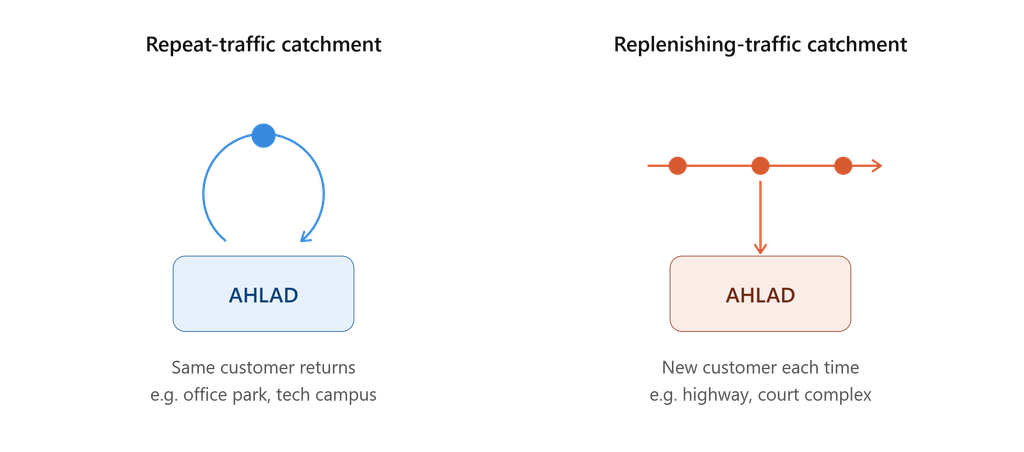
“People from different industries also keep visiting these markets. Medical Representatives, Insurance Agents, Bank Relationship Officers, Automobile Sales Executives, distributors, suppliers and other sales professionals.”
“The frequency may be different for each person. A Medical Representative may visit two or three times a month. Someone handling an AMC or regular service relationship may visit more often. Another person may come only once or twice a year.”
Mr. Singh asked,
“Then isn’t the frequency a weakness?”
Som shook his head.
“Individual frequency may be low. But the traffic is high.”
He paused.
“One person may visit twice a month, another every week and another once in six months. But every day, different people are entering the same market for different business reasons.”
“And they all need somewhere to pause,” Som continued.
“Some may have twenty minutes before their next meeting. Some may need a quick tea or coffee. Some may want something hygienic to eat. Others may simply need to sit, refresh themselves and continue their work.”
“Owners, proprietors, dealers and traders may have their own offices, shops or warehouses. But sometimes you simply want to step out, sit somewhere clean, have a good drink and refresh yourself before getting back to work.”
And Here AHLAD Fits Best. This is the Strategic Target for AHLAD
“Not as a destination café. Not as a place where someone spends an hour. AHLAD becomes the place for a quick, hygienic and refreshing pause.”
Som turned another page.
“There may be tea stalls and small food outlets, but an organised café offering hygienic, healthy food, good beverages and a proper place to refresh may have very little direct competition.”
Mr. Singh asked, “Is it scalable to other markets?”
“Yes,” Som said. “Textile markets, transport nagars, automobile markets, district courts, industrial parks, electronic markets — a few examples. Local markets, government and semi-government offices, hospitals are the best fit for the model.”
Mr. Singh’s mouth twitched. “Then perhaps the opportunity was never about finding a customer nobody else had.”
Som smiled. “It was about finding a place where my customer exists, but my competitors don’t.”
“AHLAD did not always have to compete with an existing café. It needed to find a catchment where its customer had a need that was not being properly served.”
Mr. Singh picked up his tea.
“Now you are thinking like a retailer.”
Som closed his notebook.
“So, we have the target audience.”
“Not just the audience,” Mr. Singh corrected. “You have identified the customer and the catchment where AHLAD can serve that customer.”
Som smiled.
“The target is becoming clearer.”
Mr. Singh picked up his tea.
“Good. But targeting only tells you whom you want to serve.”
Now came the next challenge.
If AHLAD wanted to win that customer, what should make the customer choose AHLAD over every other option?
Som opened a fresh page in his notebook.
At the top, he wrote one word: